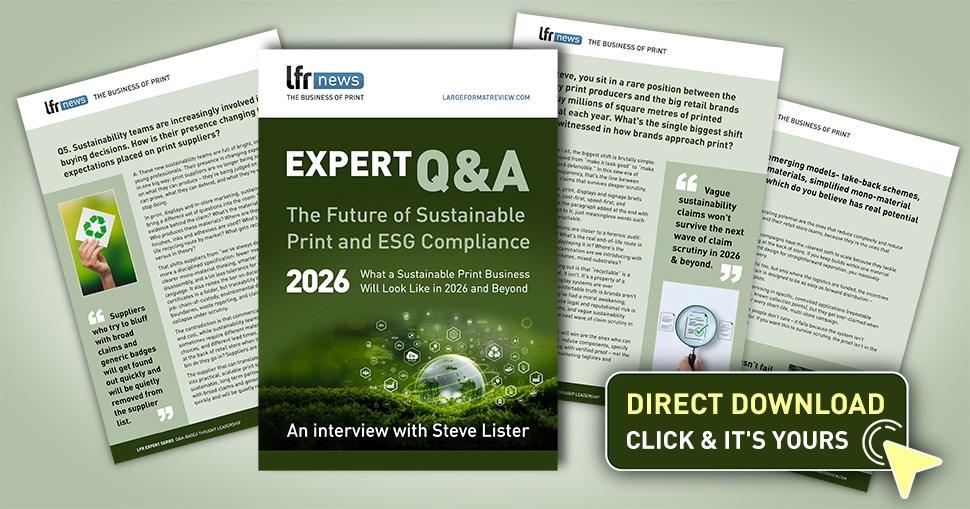


This interview with Steve Lister covers 30 questions and answers on the future of sustainable print and ESG compliance, and details what a sustainable print business might look like in 2026 and beyond, with a timely and unflinching look at what the industry must do to remain credible in the years ahead.
“What Will a Sustainable Print Business Look Like in 2026 and Beyond?” is one of the most comprehensive and practical perspectives currently available on sustainability in display print.
Rather than recycling familiar talking points, the Q&A confronts the hard realities facing printers, material suppliers and brands as green claims come under increasing scrutiny from regulators, procurement teams and sustainability specialists.
From marketing claims to defensible proof
Drawing on his unique position between global brands and the print supply chain, Lister argues that the biggest shift underway is a move away from vague sustainability language towards what he calls “transparent and defensible” claims.
Where once sustainability sat at the end of a brief, today it acts as a qualification gate. Printers are no longer judged solely on speed, price and quality, but on their ability to evidence material choices, end-of-life outcomes and carbon impacts at job level.
According to Lister, words such as “green”, “eco” and even “recyclable” are rapidly losing value unless they are backed by verifiable data that can withstand audit and regulatory challenge.
ESG pressure reshaping procurement
The expert insight explores how ESG has evolved from a corporate aspiration into a commercial filter. In some major retail tenders, sustainability now accounts for up to 40% of evaluation criteria – not as a badge-collecting exercise, but as a risk-management tool.
The Q&A highlights a growing tension between marketing teams seeking impact and speed, and procurement and sustainability teams demanding traceability, credible data and reduced exposure to greenwashing accusations. Suppliers unable to provide documentation or substantiation are increasingly being filtered out long before pricing discussions begin.
PVC-free: ambition versus reality
One of the most candid sections addresses the industry’s push towards PVC-free print. While alternatives such as fibre-based boards, PP, PET and textiles are already in use at scale, Lister cautions against simplistic “like-for-like” expectations.
The insight explains why performance requirements, process habits and cost pressures continue to anchor PVC in certain applications – and why genuine progress depends more on simplified, mono-material design than on headline substitutions.
Circularity starts at design stage
A recurring theme throughout the interview is that recyclability is not an inherent property of a material, but of a system. Mixed materials, laminates, adhesives and rushed installation and removal practices routinely undermine recycling claims.
Lister argues that most sustainability outcomes are locked in at the design stage, long before a job reaches the press. Simplified constructions, mono-material builds and realistic collection routes are presented as the most scalable routes to circularity.

Data, transparency and regulatory reality
With greenwashing enforcement tightening across the UK and EU, the Q&A examines the rising demand for carbon calculations, life-cycle assessment (LCA) principles and traceability data. It also outlines why printers risk losing major contracts if they cannot produce audit-ready documentation.
The insight references emerging tools and frameworks that aim to standardise reporting and move the sector away from inconsistent, marketing-led sustainability narratives.
A practical roadmap for the industry
Rather than leaving readers with abstract goals, the interview concludes with a clear roadmap for print businesses preparing for 2026 and beyond: tighter material control, repeatable measurement, and an honest approach to end-of-life outcomes.
Above all, Lister stresses collaboration – between brands, suppliers and printers – as the only viable path to genuine progress.
Now available
The full expert Q&A, “What Will a Sustainable Print Business Look Like in 2026 and Beyond?”, is now available to download and read in PDF form. It provides essential reading for anyone involved in print, display, POS or retail marketing who wants to understand not just where sustainability rhetoric is heading, but what will actually stand up to scrutiny in the years ahead.
Click here to download your free copy.