

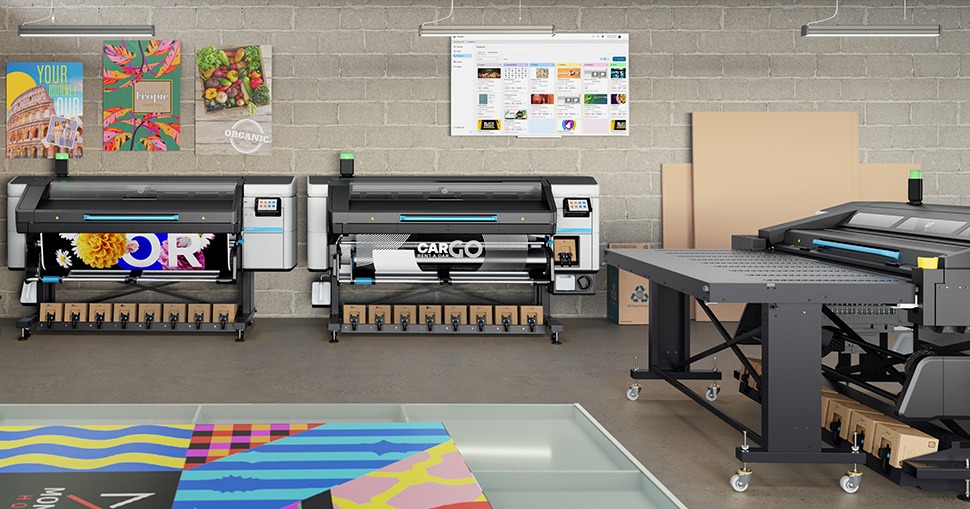
A question without a definitive answer, LFR examines the debate between investing in one high-speed press or adopting a multi-machine model, weighing up the key pros and cons of each approach to determine which strategy may work best for your business.
On the surface, many printers appear to operate in similar ways, producing comparable materials for similar customer bases. However, behind the scenes inside the printroom, production setups can differ significantly, and while output may look alike, the operational strategy driving it often varies from one company to the next.
Of course, there is no set way of running a print business. What may work well for you could be completely alien to your competitor down the road, and vice versa. Perhaps the stand-out debate in this area is how you configure your machinery: do you throw all your weight behind a single high-speed press, or adopt a multi-machine approach and spread production across several pieces of hardware?
It all comes down to personal preference as to how you want to run your business. That said, there are certainly pros and cons to the two approaches, and one method might suit you more than the other. In this feature, LFR caught up with several manufacturers and a print service provider (PSP) to offer insight to those seeking guidance on how to best approach production.
Why print investment is now a tougher decision
To kick-start the debate with a leading manufacturer, Mike Lewis, Wide-Format HQ Business Manager EMEA at Fujifilm, offered his opinion. He said while entering the market to buy new technology is an exciting moment for any business, at the same time, social and economic pressures across the modern print industry have changed investment trends.
“Buying new technology is now a more considered decision, and in an extremely congested marketplace, it can be daunting to make the right decision,” he said. “Matching technology to your core requirements, with ambitions for growth but to be within budget, whilst being supported by people and a brand which reflects your business image and ethics, is therefore paramount.
So, if you are active in the wide- and super-wide format market – a mature space – where do you begin the search for your next investment? Mike said choosing between a single or multi-solution approach very much depends on the motivation of the buyer.
“Redundancy is often a driving force behind having multiple devices, meaning if there’s a technical challenge on one device, then there’s another waiting to absorb the workload,” he said. “Adopting a multi-solution approach also offers the luxury of running two or more separate jobs at the same time, potentially on completely different substrates and, in some instances, running alternative ink sets to suit the application.
“Investing in multiple devices may also offer an opportunity to completely mix technologies and focus on their core strengths, such as partnering a roll-to-roll solution with a hybrid and/or a true flatbed.
“On the other hand, investing in a single solution, which delivers the same applications and print capacity as the multi-solution approach, can offer several benefits. These can include a smaller overall footprint, and in some cases, a lower total capital investment, whilst also being more energy efficient.
“Quicker turnaround times may be achieved, especially with the adoption of automation. One device often requires one focused operator for most of the time, with one ongoing service contract, and therefore, operational savings should also be a consideration.”
Match your print investment to growth plans
Taking this all into account, how do you know which route to travel? Mike recommended taking a “helicopter view” of your current business; include your operators when assessing where you are today, what your daily challenges are, what your ambitions are moving forward and share your findings with whoever you’re choosing to partner with. He added that the more informed a sales specialist is, the more they can help you to achieve your goals.
“Talking about applications as just one substrate may dictate the recommended ink type and the solution,” Mike said. “Be honest about the budget from the beginning, as these elements will both shape the potential solutions and shorten the qualification process. Investigate environmental considerations from both an operational and economical perspective and always keep in mind the available floorspace. There really isn’t a simple formula, as every business has unique circumstances.”
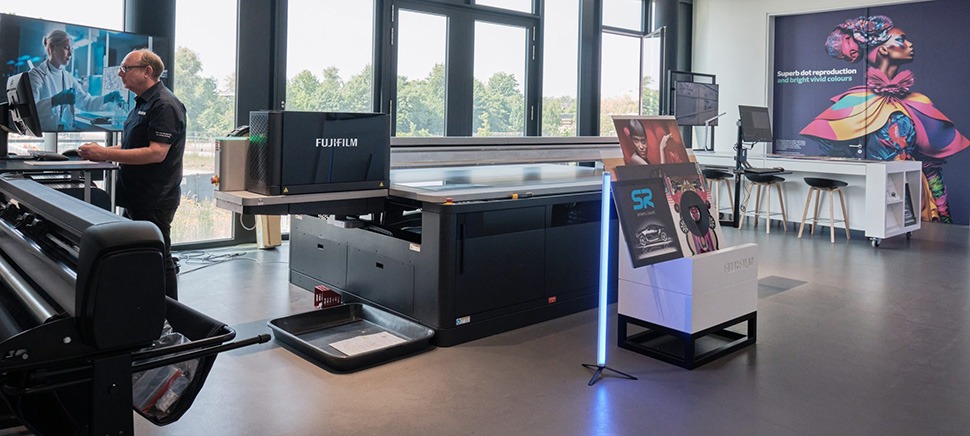
As for how Fujifilm can help companies across both approaches, Mike said the manufacturer offers a broad range of UV and LED UV technologies at varying levels of productivity and investment. He said any device could be part of a single or multi-solution approach but picked out the Acuity Ultra Hybrid range as offering the greatest headroom and versatility from one device.
“Operators in the field regularly highlight that the performance on both rigid and roll media is equally impressive, both in terms of substrate handling and ink performance, and given the 3.2m print width, an Ultra Hybrid accommodates a plethora of media and applications,” he said.
“The Acuity Ultra Hybrid LED and Pro are both modular systems, allowing customers to scale over time. For example, adding heads and therefore additional colours or even automation at a later date, as demand grows.
“Businesses are sweating their equipment for longer than in recent years, so build quality, reliable access to parts and consumables, plus trustworthy and quality support to stand that test of time, is of huge importance. At Fujifilm, we have our wide-format HQ based in the UK, inks are manufactured in Broadstairs, and our global and local service resources are designed to support customers long term – all key factors when choosing the right long-term partner.”
Start simple, then scale as demand increases
Elsewhere, Stuart Thomas, Business Development Manager, Large-Format, at HP spoke about the main positive and negative points of each approach. He said some print companies choose to invest in one fast, versatile printer and run a wide mix of work through it, which keeps the operation simple; fewer machines to manage, easier training, lower space and energy costs, and consistent colour.
“It works well when the job mix changes regularly and when speed, flexibility, and margin matter more than running maximum volume all the time,” he said. “However, the obvious downside of a single‑printer setup is risk. If that machine is down, production stops, so service support and reliability really matter.
“With a multi‑machine model, this gives more resilience and makes scaling easier once volumes grow. Adding a second or third printer allows work to run in parallel, reduces dependency on any one device, and helps handle seasonal peaks. The trade‑off is more complexity, higher running costs, and the need to keep all machines busy to justify the investment.”
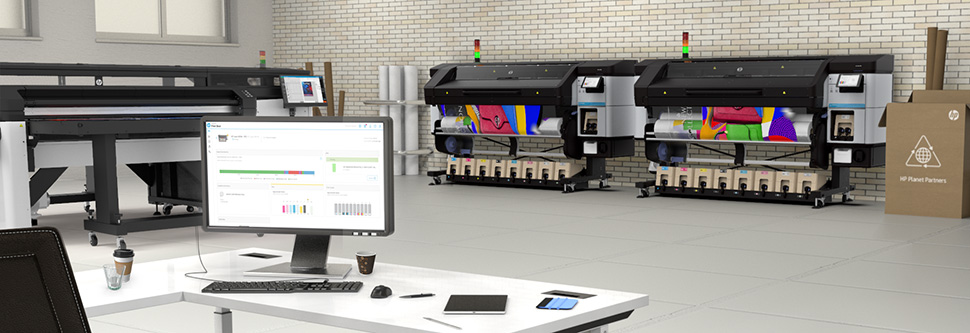
Stuart said this is where the HP Latex R2000 fits nicely, setting out how it is “productive and flexible enough” to start as a single main production printer. He added that it also scales well as the business grows, either by adding another R2000 or complementing it with roll printers.
“That gives a clear growth path: start simple, then build in capacity and resilience when the volume is there,” he said.
The right print setup depends on your workflow
Another manufacturer weighing in was Roland DG. Rob Goleniowski, Regional General Manager for the UK, Ireland, Scandinavia & Baltics at Roland DG Europe, said that when it comes to production strategy, there is no universal right answer; only what best supports the way your business works today and how it plans to grow tomorrow.
Jumping straight into the debate, Rob said: “A single, faster all-in-one machine appeals to businesses that value simplicity and efficiency. By combining printing and cutting into one streamlined workflow, it reduces handling, saves space, and makes it easier to keep production moving with minimal intervention. This approach is especially attractive for smaller teams or environments where floor space, staffing, and setup time are at a premium. With fewer moving parts – both literally and operationally – it allows operators to focus on output rather than process management.
“On the other hand, a multi-machine model is built around throughput and flexibility. By separating printing and finishing into dedicated devices, businesses can run jobs in parallel, printing on one machine while cutting on another. For higher-volume environments or operations juggling multiple job types and deadlines, this approach can offer greater long-term efficiency.”
Rob went on to say that the decision comes down to understanding your workflow and not just your equipment. He recommended businesses start by looking at their job volume and turnaround expectations, saying how lower to moderate volumes with varied job types often benefit from the simplicity of an integrated solution, whilst consistently high volumes tend to favour parallel production across multiple machines.
On top of this, Rob said both space and staffing play a role. He said: “A compact, all-in-one system may be the smartest choice where space is limited or where one operator manages multiple tasks. Meanwhile, larger production floors with dedicated operators can take fuller advantage of a multi-machine setup.
“Finally, it’s worth considering future growth. Some businesses prefer a single versatile machine that delivers immediate capability with minimal complexity. Others plan ahead, choosing modular setups that allow them to add capacity or specialisation over time without replacing existing equipment.
“In short, the best choice is the one that aligns with how your business operates today – and how you expect it to evolve.”
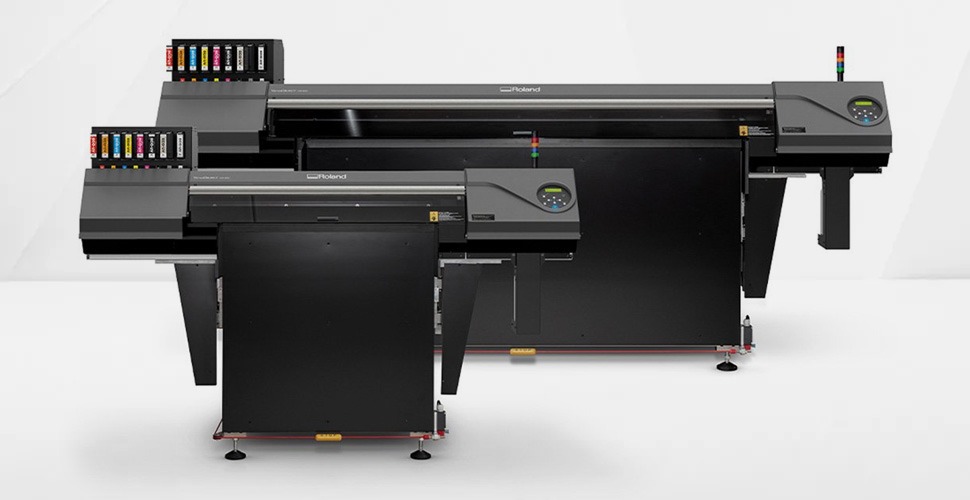
As to what Roland DG offers, Rob said that the manufacturer has a range of integrated print-and-cut systems, designed to bridge the gap between simplicity and capability. He added these devices offer the convenience of an all-in-one workflow whilst delivering the performance needed to handle a wide range of applications – from short-run graphics to more demanding production schedules.
“For growing businesses in particular, these kinds of machines can act as a foundation: efficient enough to run as a standalone production solution, yet flexible enough to slot into a broader multi-machine setup later on, if volumes increase,” he said. “It’s a way to invest in versatility now without closing the door on scalability in the future.”
Consider what works for your business
Having heard from three manufacturers, what becomes clear from both perspectives is that the debate is less about speed versus scale, and more about risk appetite and workflow design. Now, it is only fair that we also get the opinion of a PSP; after all, they are the ones running these machines day in, day out.
Nathan Swinson‑Bullough, Managing Director of Imageco, said there are pros and cons to both approaches, and ultimately this depends on the type of business you run, the work you produce, and your overall operating model.
“I don’t know many companies that operate with just one fast machine,” he said. “If the work were highly repetitive, standardised, and high-volume, then a single high-speed machine could make sense. That said, I would personally feel very nervous relying on one core asset; if that machine were to break down, the business would be left extremely vulnerable.”
Nathan said while the advantages of this approach are clear in terms of reduced operator and staff training, steadier overheads, and strong colour consistency, the risk profile is high. With this, he set out how Imageco runs a multi-machine model, “significantly” helping to reduce exposure to breakdowns and bottlenecks
“Few printers operate with completely open contracts that can run entirely on a single machine,” he said. “Even trade-focused businesses typically deal with a wide range of materials, job specifications, and production processes that naturally require multiple machines. Today’s machines are also far easier to operate than they once were, and with good colour management in place, colour can be matched very accurately across platforms.
“Unless I were a very small one- or two-person operation, I wouldn’t consider going down the single-machine route.”
Imageco operates a mix of hybrid and roll-to-roll platforms. Its line-up includes a swissQprint device for high-quality, creative output and a large proportion of its board work, while it also doubles as a volume printer when demand requires it. Also in place is an EFI Vutek, which handles mainly large-format roll work, while its HP Latex 830 machines cover a high volume of smaller-format jobs such as pull-ups, wallpaper, and stickers.
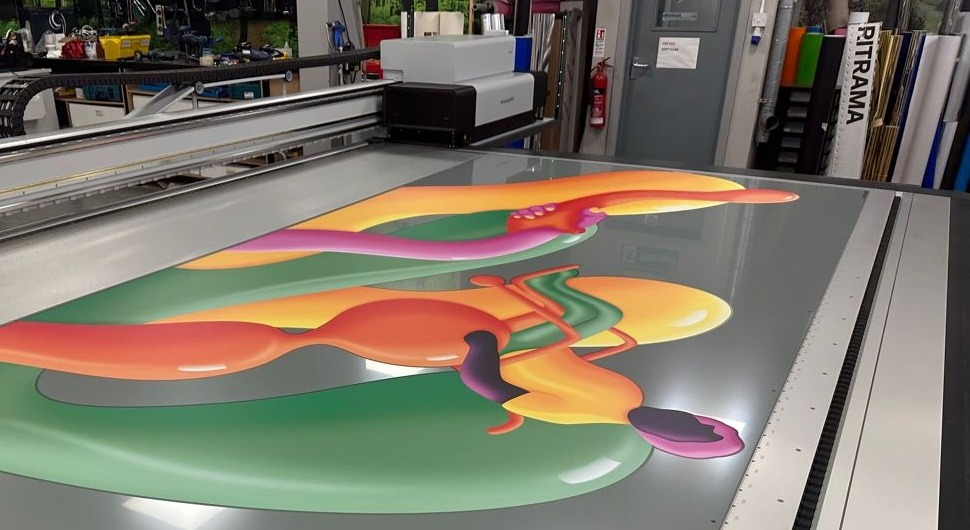
But that is not all; Imageco also works closely with several trade partners for support during peak periods, which Nathan said ensures the company is effectively covered across all applications.
“Our volumes sit firmly in the mid-range, but the work itself is highly creative and varied,” he said. “For that reason, a multi-machine model isn’t just a preference for us; it’s essential.
“For me, it’s fairly straightforward to see what we need. We constantly assess the business in terms of what we can service well today, but also which markets we can realistically push into. Over the years, we’ve spent a lot of time evaluating machines that genuinely suit the type of work we do.
“I make a point of staying up to date with new technology and using that knowledge to leverage what we can offer as a business. I also recall a time, before I was MD, when some poor machine investment decisions were made. While many of those choices looked right on paper, the ones that didn’t work have stayed with me, and I’m conscious not to repeat those mistakes.
“I think carefully about our workload and the diversity of the work we produce, and I’m always considering what best suits us operationally rather than chasing capability for the sake of it.”
As predicted at the start of this feature, there is seemingly no end to this debate. It all comes down to what sort of business you run and how to best address the demands of your customer base. It is entirely feasible for you to switch from a single-machine model to running multiple machines, but only if the demand is there for work. There are certainly pros and cons to each method; it is all about weighing up what will serve you best.
Key Takeaways
- The article explores the debate of Single vs Multi-Machine Setups in printing, weighing the pros and cons of each strategy.
- Operators should assess their workflow, current capacity, and future growth when choosing between single and multi-machine models.
- Investing in multiple machines enhances redundancy and flexibility but involves higher costs and complexity.
- Conversely, a single high-speed press offers simplicity, quicker operational needs, and potentially lower energy use but presents reliability risks.
- Ultimately, the best choice depends on individual business needs, job types, and long-term objectives.