
If you want to understand where wide-format print is heading, perhaps you should pay less attention to the steady stream of product launches and promises, and more attention to the actual unit sales of hardware itself.
Of course, accessing reliable print-market sales data is far from straightforward. Much of it is compiled by industry analysts such as IDC, Smithers, Keypoint Intelligence and I.T. Strategies, using methods that range from shipment tracking and vendor data to interview-led market modelling and triangulation from public sources, trade data and economic proxies where direct figures are missing. That makes the results more than guesswork, but not always hard fact.
At LFR, we have of course used our own levels of abstraction, injected additional external inputs from a variety of datasets, channel feedback, OEM shipment signals, install base observations etc, and then reframed our model. Here’s our summary of where we are in terms of global printer shipments:
| Category | 2025 est. units | CAGR to 2030 | 2030 proj. units |
|---|---|---|---|
| Aqueous | 18.0K (30.4%) | 0.0% | 18.0K (29.6%) |
| Eco-Solvent | 18.9K (31.9%) | -2.0% | 17.1K (28.1%) |
| Latex | 4.4K (7.4%) | 5.4% | 5.7K (9.4%) |
| UV-Curable | 9.8K (16.6%) | 1.4% | 10.5K (17.2%) |
| Dye-sub / textile proxy | 8.1K (13.7%) | 3.4% | 9.6K (15.8%) |
| Total | 59.2K | 60.9K |
Loyalty matters, but practicality matters more
Printers get bought for practical reasons. Shops invest when they believe there will be enough work, enough margin and enough long-term demand to justify the machine, the space it takes up, the staffing around it and the cost of keeping it running. Hardware trends are not a perfect forecast, but they are still a useful way to see where the market thinks future demand will be.
One caveat first: this “global” picture excludes China, which is sensible enough. China is large, busy and internally complex enough to distort everything around it. So, this is really a view of the rest of the world.
What that view suggests is not a boom. It is a reshuffle.
The total wide-format graphics hardware market looks broadly stable, sitting at around 59K units a year in 2025 with slight growth to just over 60K through to 2030. This is not a story of dramatic overall expansion. The real movement is inside the mix. Some technologies are picking up ground. Some are levelling off. Some technologies retain large sales but are clearly no longer where the strongest momentum sits.
The mainstream market
At the mainstream end of the market, eco-solvent still holds the largest share. That matters because it remains the default production technology for a huge amount of everyday sign and display work. Nothing in these numbers suggests it is about to disappear.
But it does look mature.
Eco-solvent is projected to ease down from near 19K in annual unit sales to around 17K by the end of the decade. That is not collapse. It is the shape of a category that is still important, still widely used, but no longer setting the pace.
Latex shows the clearest growth pattern in the mainstream market. Annual sales move from the 4.4K towards roughly 5.7K units by 2030, representing a CAGR of 5.4%. That is a meaningful shift. More PSPs clearly see latex as a practical answer to a combination of modern requirements: indoor suitability, broader application range, fewer issues around odour, and a better fit with customers asking tougher questions about safety and environmental performance.
Soft signage is the other obvious growth area. Hardware for dye-sub soft signage rises from circa 8.1K to 9.6K. That matters because soft signage has been talked about for years as a future opportunity. These numbers suggest it is no longer just a talking point. It is a category now attracting real investment.
UV sits in a different place. Growth is modest, there is no sign of a breakout, but importantly no sign of retreat either. UV looks established, commercially important and dependable, which is not a bad place to be. It just is not the part of the market showing the strongest growth curve.
Elsewhere, aqueous doesn’t move. It is still there, still useful where it fits, but it does not appear to be where the market expects fresh momentum.
So, the mainstream picture is fairly clear. The overall market is stable, but inside that stability latex and soft signage are gaining ground, eco-solvent remains the volume leader while gradually easing back, and UV continues to hold its place as a solid production technology.
What that means for print service providers
If you are a PSP or signmaker planning the next five years, the obvious mistake is to look only at what you sell now and buy another machine to do more of it. That may be necessary in some cases, but it is not the same thing as strategy.
The better question is which technologies buyers are backing because they believe demand will be easier to build around them in the years ahead.
On that reading, latex and soft signage look healthier than eco-solvent. UV remains highly relevant, especially where rigid work, specialist applications or production flexibility drive the economics, but it looks more like steady industrial muscle than a rising tide.
That does not mean every shop should rush out and buy latex or dye-sub. It does mean expansion plans should probably be framed around applications, not just output speed. More capacity in a mature lane is one thing. Access to work that is still gaining share is another.
The high-end market
The higher end of the market tells a cleaner story, largely because of what is missing.
Aqueous is absent. Eco-solvent is absent there too.
That matters.
When capital cost rises and the brief shifts towards industrial throughput, automation, productivity and harder commercial intent, buyers are not reaching for premium aqueous or industrial eco-solvent. They are buying high-end UV hybrids, flatbeds or roll-to-roll, high-end soft-signage platforms and higher-end latex machines.
Higher-end latex looks strongest as a source of new revenue, growing from a little over 300 annual units towards roughly 400, with growth around 5%. It is a small market in absolute terms, but that is the nature of this tier. These are not casual purchases. They are deliberate bets on where industrial graphics production is heading.
High-end UV flatbed grows more steadily, from just above 300 units into the mid-300s, with a CAGR around the 2% mark. That looks like a mature industrial segment that still matters deeply. It sits where rigid productivity, direct-to-board capability and higher-value applications keep it commercially central.
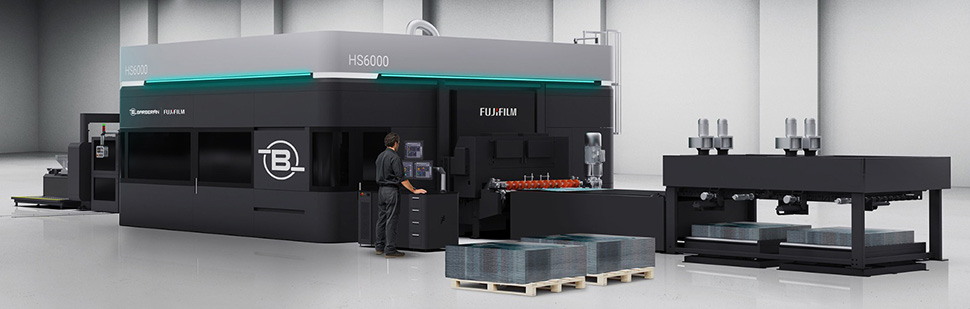
However, there is one corner of UV that still feels less like mature infrastructure and more like an advance guard: ultra-high-end single-pass UV. In that segment, machines like Barberan’s HS6000 or the EFI Nozomi have systems aimed squarely at sign and display work, printing typical graphics substrates at industrial speeds that push digital into territory historically associated with offset analogue production. The interesting part is not just the speed, it’s that for the right business, single-pass UV starts to make the ultra-high-volume digital production of graphics look increasingly viable. But it is only viable for those businesses doing the necessary volumes to justify the outlay.
High-end soft signage remains the smallest category in pure unit terms, moving from just above 100 units into the low 100s. That is not a mass market. It is specialist industrial adoption, which may be more interesting. It suggests serious textile and soft-signage production is still attracting investment from businesses that know exactly why they are spending the money.
The lesson in the missing categories
The absence of aqueous and eco-solvent at the high end says plenty on its own.
Those technologies still have a clear place in mainstream production. Eco-solvent, in particular, remains a large and important part of the everyday sign and display economy. But when buyers move up into the industrial tier, they are choosing platforms built for speed, throughput, automation and application breadth. That is where UV remains strong. That is where industrial dye-sub keeps its place in volume textile work. That is where latex carves out a role where application fit, compliance and environmental positioning carry real commercial value.
That distinction matters if you are planning growth, because “do more of what I already do” and “move into more valuable work” point to different machine decisions.
So where should PSP businesses look?
For mainstream PSPs, the strongest forward signals sit with latex and soft signage. That is where the healthier growth lines are. UV remains valuable and, in many businesses, indispensable. Eco-solvent still leads the market by volume at the lower end, but the direction of travel is contracting and less exciting than it once was – replacement rather than investment is perhaps the new norm there.
For businesses looking further upmarket, the pattern sharpens. The industrial tier is not spending on aqueous or eco-solvent. It is spending on UV flatbed, UV roll-to-roll, industrial soft signage and high-end latex. Among those, high-end latex looks the liveliest, while single-pass UV hints at something else again: digital moving into volumes and use-cases that would once have been written off as analogue offset territory.
The short version is this: the next few years will not reward everybody equally. They will sort the market.
Mainstream wide format stays large and mature. The eco-solvent market is softening. UV stays essential. Latex and soft signage carry the stronger growth story. At the industrial end, the capital is already showing where confidence sits.
That is how technology markets usually change. Quietly at first. Then more obviously, once enough people notice where the investment has been going.
FAQ: Wide-Format Print Hardware Market to 2030
No. The total market looks broadly stable, moving from around 59,000 annual units in 2025 to just over 60,000 by 2030. The bigger story is not total growth, but which technologies gain or lose share.
Latex shows the clearest mainstream growth profile in this analysis, rising from around 4,400 annual units to roughly 5,700 by 2030.
Yes. Eco-solvent remains the largest mainstream category by volume. The point is not that it disappears, but that it looks mature and gradually softening rather than expansion-led.
Soft signage is no longer just a “future opportunity” story. Hardware sales for dye-sub soft signage rise from around 8,100 to 9,700 units, which points to continued real investment.
UV appears established, dependable and commercially important. It is not the standout growth segment in the mainstream market, but it remains central, especially where rigid media, specialist work and production flexibility matter.
Because when buyers move into the industrial tier, the emphasis shifts towards throughput, automation, application breadth and harder commercial intent. In that environment, investment concentrates around UV, industrial textile platforms and higher-end latex.
Buying more capacity in a mature category is not the same as buying access to future demand. The smarter question is which technologies are gaining backing because they open up healthier application areas over the next five years.
No. The market view presented here explicitly excludes China, because China is large enough and structurally distinct enough to distort the wider picture.
It shows where buyers place their highest-confidence capital bets. At that level, the market is not leaning into aqueous or eco-solvent. It is leaning into UV, soft signage and latex.
Because it signals where digital print starts to compete with analogue-scale production economics. It is not a mass-market purchase, but it is strategically important for very high-volume businesses.
Summary
The wide-format print hardware market to 2030 looks less like a growth boom and more like a reallocation of confidence. Total annual hardware volumes remain broadly stable, but the mix changes meaningfully.
Eco-solvent remains large but mature. Latex and soft signage carry the stronger mainstream growth story. UV stays highly relevant, especially in production environments where rigidity, flexibility and application breadth matter.
At the industrial end of the market, the signal sharpens further: capital is concentrating around UV, textile and higher-end latex rather than aqueous or eco-solvent.
For PSPs, the practical implication is clear enough: the next few years are less about buying more of yesterday’s volume and more about deciding which applications and technologies are most likely to hold or win revenue share.
Wide-Format Print Hardware Market: Key Data Points to 2030
Scope note: This analysis refers to the global wide-format graphics hardware market excluding China.
| Segment | 2025 | 2030 | Direction of travel | What it suggests |
|---|---|---|---|---|
| Total market | ~59,000 units | Just over 60,000 units | Broadly stable | The market is not booming; the real change is inside the mix |
| Mainstream eco-solvent | ~19,000 units | ~17,000 units | Down c.10.5% | Still the volume leader, but mature and easing |
| Mainstream latex | ~4,400 units | ~5,700 units | Up c.29.5% | The clearest mainstream growth story |
| Mainstream dye-sub / soft signage | ~8,100 units | ~9,700 units | Up c.19.8% | Continued investment in textile and soft-signage applications |
| Mainstream UV | ~9,800 units | ~10,500 units | Up c. 7.1% | Established and commercially important, but not the fastest-growth segment |
| Mainstream aqueous | Flat | Flat | Little movement | Still relevant where it fits, but not where fresh momentum sits |
| High-end latex | Just over 300 units | Roughly 400 units | Up by around one-third | Strongest growth signal in the industrial tier |
| High-end UV flatbed | Just above 300 units | Mid-300s | Steady growth | Mature industrial segment with durable demand |
| High-end soft signage | Just above 100 units | Low 100s | Small but positive | Specialist industrial adoption rather than mass-market expansion |
| Aqueous / eco-solvent at high end | Absent | Absent | No industrial traction | Buyers at this level are prioritising throughput, automation and application breadth |