
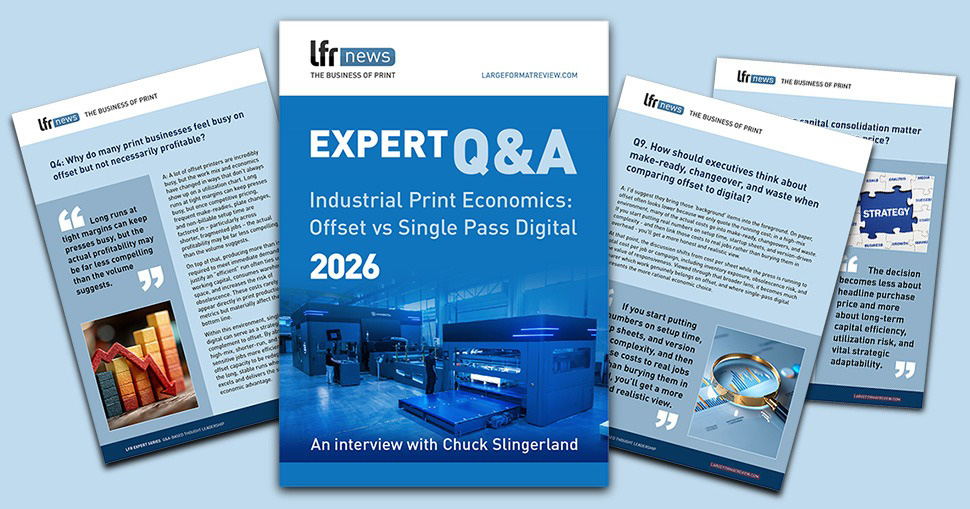
LFR is delighted to publish a new expert Q&A report exploring the economic realities of offset and single-pass digital production in industrial print environments. Entitled Industrial Print Economics: Offset vs Single Pass Digital 2026, the report is available to download free of charge from today.
The discussion comes at a time when digital inkjet continues to gain market share globally. According to Smithers’ The Future of Print to 2030, the global value of output produced via web offset declined from $94 billion in 2015 to $62 billion in 2025, with further contraction forecast. Over the same period, digital inkjet output more than doubled from $49 billion to $108 billion and is projected to reach $136 billion by 2030.
On why they commissioned the Q&A, Marc Burnett at LFR explained: “Print was once defined by distinct disciplines – screen, wide-format and offset – each operating in its own world. Digital technology has changed that.
“Wide-format provides a useful benchmark because it was the first sector to commercially embrace digital inkjet at scale, and the businesses that succeeded developed skills and expertise that are directly transferable to other areas of digital print. Offset is simply the next stage in that evolution.
“We commissioned this report to give decision-makers a practical, economics-focused perspective on what that transition really means in the real world, helping them understand both the opportunities and the challenges involved.”
The LFR report features 30 in-depth questions and answers with Chuck Slingerland, Vice President of Barberán Corrugated North America, who brings a unique perspective shaped by both operational and technology leadership experience.
Prior to joining Barberán, Slingerland led Abbot-Action’s transition from litho label production to single-pass digital printing in 2016, making the company one of the earliest adopters of the technology in North America.
Drawing on his first-hand experience with Abbott Action’s corrugated operation and his leadership in its digital transformation, Slingerland offers practical insights into the financial, operational, and strategic factors that shape investment decisions across today’s print sector.
Rather than assuming digital technology is inherently superior, the report examines the true costs associated with traditional offset production, including make-ready times, changeover waste, plate remakes, inventory holding costs, product obsolescence and how choosing the right ink technology supports an evolving strategy.
Chuck Slingerland explains: “Many companies still compare offset and digital using cost models that fail to account for inventory, waste and changeover costs. These expenses are often absorbed into overheads and therefore overlooked when assessing overall production efficiency.
“When those factors are properly measured, the economics often look very different.”
Across the 30-question discussion, the report explores cost-curve dynamics, capital investment strategy, asset lifecycle economics, workforce considerations and the practical distinctions between industrial single-pass systems and other digital print technologies. Particular attention is given to the financial perspective, highlighting how the primary value of single-pass digital production often lies not in lower unit costs, but in reducing business risk through shorter production runs, lower inventory requirements, fewer write-offs and improved cash flow management.
The report also challenges long-held assumptions around offset efficiency. While offset remains highly effective for long, stable production runs, the economics become less favourable for increasingly common applications characterised by shorter runs, greater SKU proliferation, versioning and customisation. In these environments, costs that have traditionally remained hidden within operational overheads become increasingly significant.
In addition, the document examines the financial impact of delaying investment decisions and the implications of relying on production technologies for applications they were not originally designed to serve. A vital role of this analysis is ensuring that ink manufacturers – such as Fujifilm who partnered with Barberán for the Nautilus project – has a full suite of ink sets with distinct USPs and performance characteristics. This enables users to maximise production efficiency and print quality across a broad spectrum of substrates, including lightweight papers, corrugated board, vinyl, styrene and polypropylene.
For print businesses facing increasing pressure to produce shorter runs, manage more SKUs and respond faster to customer demands, understanding the true cost of production has never been more important. Industrial Print Economics: Offset vs Single Pass Digital 2026 offers practical insights and real-world experience to help decision-makers evaluate when offset remains the right choice and where single-pass digital can deliver measurable operational and financial benefits.
To download the report free of charge, click here.
Key Takeaways
- LFR published the Industrial Print Economics Report examining offset versus single-pass digital production in industrial print settings.
- The report shows digital inkjet market share is rapidly increasing while the offset market is forecasted to decline.
- Illustrating key insights from expert Chuck Slingerland, the report discusses the economic realities of both production methods.
- It highlights hidden costs in offset production, including waste and changeover times, when comparing to digital printing.
- The report aims to help decision-makers understand the financial implications of production choices in the evolving print landscape.
FAQ
That’s exactly the question Chuck addresses — and the answer is more nuanced than a simple yes or no. It depends entirely on your actual job mix, and whether the profitability you’re seeing today is structural or quietly eroding. The full interview works through this in detail.
It’s less about total volume and more about how that volume is composed. Chuck explains why the crossover point is often closer than it looks, and what the numbers most businesses rely on are actually missing.
It has, but not uniformly across all platforms. Chuck is direct about which claims hold up at industrial scale and which don’t. The distinction matters before you commit to a site visit or an evaluation process.
There is one. Chuck makes it. The full interview doesn’t oversell digital, it’s more useful than that.
Chuck’s answer to the final question in the interview is probably the most practically useful thing in the document. It’s worth reading before you have any further conversations with vendors.
Download the full interview PDF.