


Senior product people at big manufacturers are in a difficult position at trade shows. They know more than they can say, and they’re good at being interesting without being specific. It’s a skill, honestly. You have to learn to read between the lines, and then, if you are polite and wish to maintain their trust, you seek permission to use what you pulled from their meaningful pauses.
Oscar Vidal, HP’s Global Director of Product Portfolio and Strategy for Large Format Printing, did some of that. Of course he did. He’s a professional and he works for a public company and there are things he cannot say. But there were also moments in this conversation where he just… answered the question. Plainly, specifically, with useful info, revealing insight, and actual admissions. That doesn’t always happen. When it does, it’s worth paying attention.
So here is what he told us, and here is what we think it means for you.
The R530 creates a category of its own
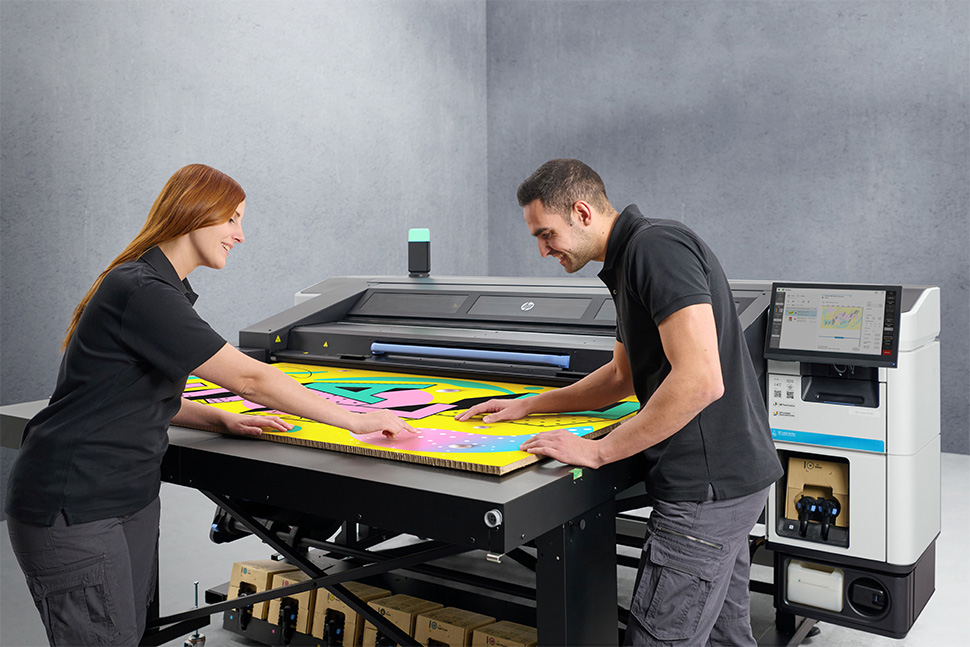
The HP Latex R530 launched nearly a year ago as something the large format print market hadn’t seen before: an all-in-one rigid and flexible machine with a footprint that didn’t require you to restructure your shop floor to accommodate it. It was also at ‘nice car’ money rather than ‘nice house’ money. That matters too. Of course, the sceptical take at launch was that all-in-one products compromise on everything. The market gave that preconceived notion a fair hearing, and then mostly rejected it, because word soon got out that the R530 was delivering on its promises.
“Whether we go from Australia all the way to South America, obviously in Europe and in North America,” Vidal told us, “We are very satisfied with the sales of the platform, with the performance of the platform. The customer satisfaction of users using it is extremely high.”
That’s not just a sales line. The real tell was the FESPA showfloor: the HP Latex R530 was still pulling crowds almost a year post-launch. That doesn’t happen with products that are merely fine. It happens when something has genuinely disrupted a category. Buyers who haven’t pulled the trigger yet keep coming back to look at it because there’s nothing else that does the same thing at the same size. The category the HP Latex R530 created still belongs to the HP Latex R530 alone.
Now, what you actually want to know: is there a bigger version coming? Or maybe your preference is for a smaller one at an even more accessible price point?
Oscar Vidal answered this with notable directness for someone who might normally prefer not to confirm anything that speculative. He views the HP Latex R530 all-in-one as the starting point of a broader range, with potential additional options currently under consideration
Fixing the operational chaos behind print production
This is the part of the conversation that could and should matter most to working print shops, yet it’s the part that tends to get buried under the gloss of hardware announcements.
The sign industry has a structural problem with operations. Not because shop owners are chaotic people, but because the tools available to them have historically been terrible. The standard setup at a small or medium print shop for most of the last two decades has been a job management system cobbled together from spreadsheets, whiteboards and human memory, with an owner who has to be personally involved in every decision because no system exists to keep track.
HP’s Production Hub, part of the HP PrintOS suite, is an attempt to fix that. It’s a production management platform that handles job intake, queue management, printer status and utilisation.
“We wanted to make sure that we helped them transform,” Vidal said. “Making that simplification process real and accessible. It’s not just theory. In hours and in days you are using it.”
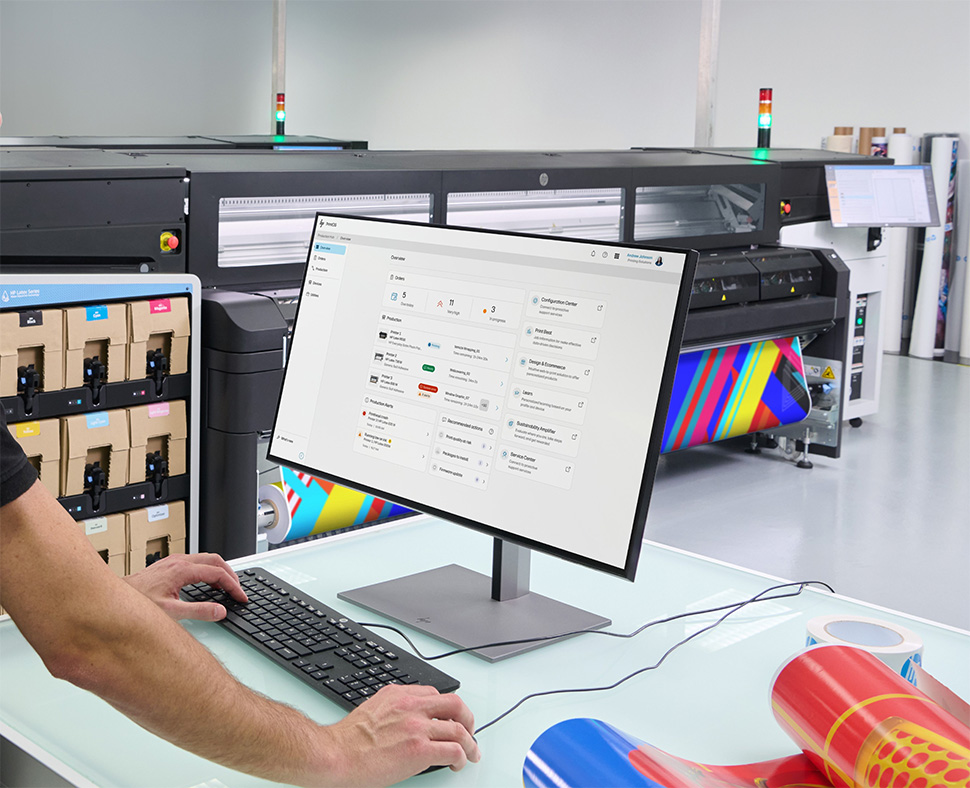
The capacity planning piece is just as significant, and just as absent from most small shops right now. Before live production visibility, promising a turnaround time was guesswork dressed up as customer service. Production Hub means you know whether you’re at capacity before you make any such commitment.
Here’s where it gets interesting. Production Hub works with any printer for the order management functions. You can run it with a Roland or a Mimaki in your fleet and still get your jobs organised. But the deeper integration, live job tracking, printer status, estimated completion times – essentially the printer telling the software what it’s doing rather than the other way around – only happens with HP devices.
“If you are using Production Hub with HP devices, that is a big plus. Because then you understand where your job is in the printer,” explained Vidal.
HP PrintOS Production Hub is a well-designed, genuinely useful piece of software that solves a real problem the industry has had for years. It is also, inevitably, a retention mechanism. The more of your production that runs through it, and the more HP hardware feeds data back into it, the more reason you have to keep buying HP. That is part of the strategy, one that justifies building an entirely new software platform from scratch, and Vidal didn’t pretend otherwise.
It’s the right move for HP and, if the product does what it claims, for the shops using it. The sign and display print industry deserves better operational software. If HP is building it and it works, that’s good. The question every print shop should be asking is: does it really work? The answer we’re getting from early adopters is yes, with some caveats around complexity at scale. A three-month trial is available for eligible customers. Take it, because three months is more than enough time to know whether this changes how you work for the better.
The conversation around Latex has changed
Let’s be honest about the history, because Vidal was.
Earlier HP Latex printers had issues, some technical, some problems of perception. Shops that were on the fence about latex used those problems, typically relayed to them by someone selling an alternative technology, as a reason to stay on the fence or to stick with eco-solvent or UV. Dependent on specific applications and planned usage, that was often a rational response to the evidence at hand.
“We went through a bit of a roller coaster for some months,” Vidal said, “and the fact that the HP Latex 700 and 800 series was launched during Covid did not help. But thankfully that’s all behind us.”
We believe him. Not because HP said so, but because we’ve been talking to shops running the HP Latex 630, 730 and 830, and the conversations are different now. Earlier generation Latex complaints have been replaced by conversations about throughput, substrate range, and whether to add a second unit. That is a different class of problem entirely.
We also went to Barcelona to spend time with the HP Latex 730 and HP Latex 830 in front of a technician rather than a salesperson. What we found there gave us specific reasons to back up what Oscar Vidal is telling you.
For example, HP Pixel Control, the ink distribution technology in the current generation, delivers the same output quality at 8-pass that the previous HP Latex 700 series needed 12-pass to achieve. That is a genuine 33% speed gain on like-for-like work, not a marketing rounding. Push to 12-pass on the HP Latex 730 or HP Latex 830 and you get print quality the previous generation couldn’t match at any speed: smoother colour fades, better transitions, and banding eliminated on even the historically difficult colours (e.g. those midtone khaki greens that used to be a lottery).
The media feeding system was rebuilt too. Eight wallpaper production companies beta-tested the new machines across thousands of linear metres of tiled work, and all of them confirmed the improvement. Anyone who has chased a tiling misalignment across a 50-metre wallpaper run knows exactly why that matters. And for print shops running white ink, the HP Latex 730W and HP Latex 830W white modes are up to 50% faster than their predecessors. That speaks for itself.
Vidal was also clear that sales on the current generation of Latex machines are strong, and that the HP Latex R530 is adding to that business rather than replacing it: “The HP Latex R530 is incremental business to us,” he said.
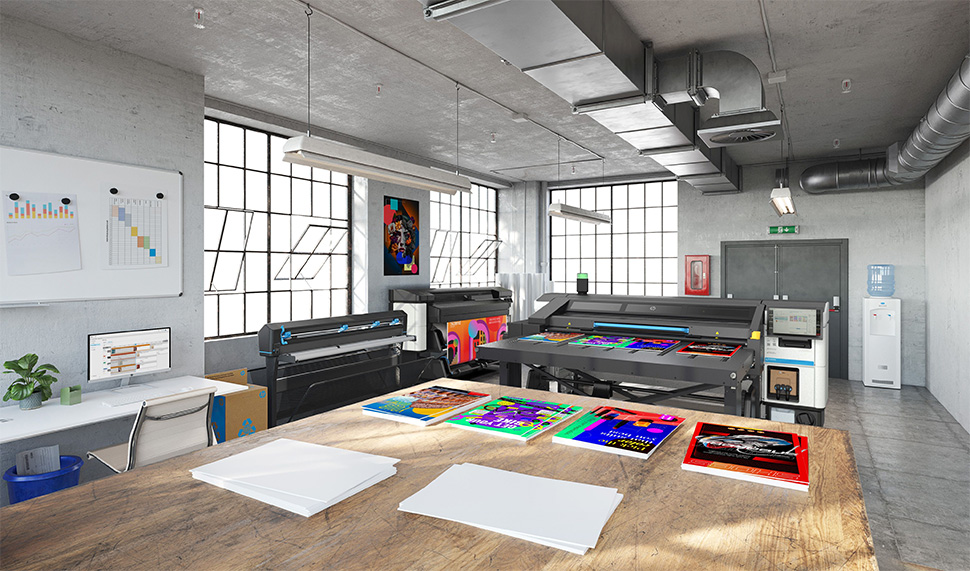
The HP Latex lineup now covers genuine price-point spread: entry configurations through to production-volume machines, print and cut options, white and colour, 64-inch formats across the range. You can build an HP Latex fleet that scales, which wasn’t always true.
Why past conclusions may no longer apply
This is the question a lot of shops won’t ask out loud, because asking it means admitting they’re reconsidering. So, we asked it for them.
Oscar Vidal had a three-part answer. New product categories: the HP Latex R530 probably didn’t exist when you made your last call about HP Latex, and an all-in-one rigid and flexible machine is a different conversation from the wide-format banner printer you evaluated in 2020. Expanded applications: Latex substrate range has grown, and things that weren’t practical a few years ago, certain overlapping wallpapers, specific specialty materials, are practical now. And the ecosystem argument: HP PrintOS Production Hub gives HP devices a layer of operational integration that nothing else in the market currently matches.
But the argument we found most convincing was the one Vidal made almost as an aside. HP is on its fourth generation of latex. Other vendors are now moving into water-based and latex-adjacent technologies. Vidal noted this with evident satisfaction, and he’s entitled to. When your competitors validate your technology category by trying to enter it, that means something.
“We’ve been more than 17 years in this business,” he said, “and we know how to make this technology to the maximum level of performance.”
Seventeen years is not a marketing number. It’s the difference between a manufacturer still learning what its technology does under sustained real-world production load, and one that learned that fifteen years ago. HP found the limits. HP fixed them. The HP version of latex is mature. The machines we tested in Barcelona were the proof.