

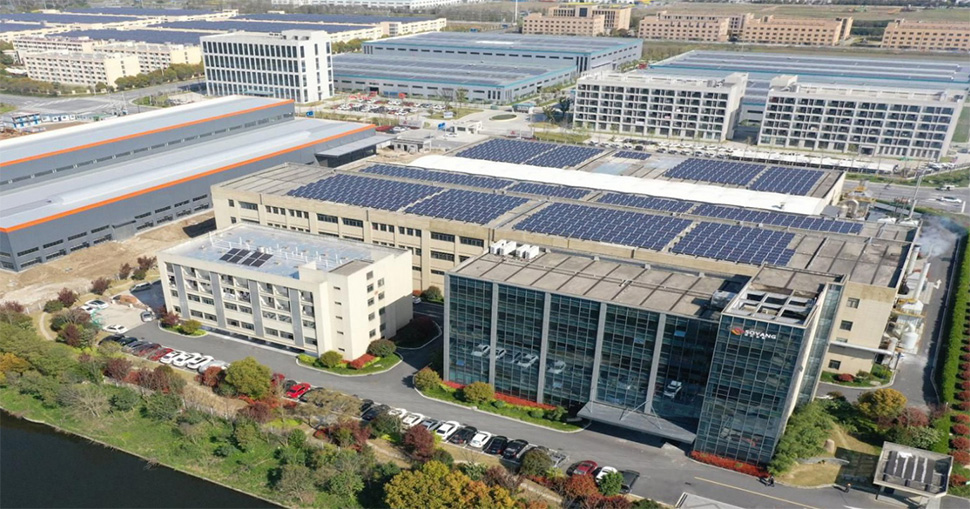
In February 2026, I wrote about a pending visit to APPPEXPO in Shanghai. Two days later, Mark Mashiter, Chairman and CEO of Soyang Europe, called with a perfectly fair suggestion: if I was going all that way, why not go and see where some of this stuff is actually made?
So, the day after we wrapped up at APPPEXPO, there I was in Haining, Zhejiang, standing in Soyang’s logistics centre, looking at what can only be described as mountains of finished textile media waiting to leave for countries all over the world.
And there was the first useful jolt of honesty.
A lot of it was not wearing Soyang’s name.
Anyone who has spent serious time around manufacturing will recognise the pattern immediately. This is one of those things everybody in the trade knows, but not everybody likes to say out loud: a good chunk of the global print-media and textile business is built on a complicated dance between the brand on the box and the factory that actually made what is inside it.
Soyang comes out of exactly that world. Its story starts in 1999, when Lily Li launched the DAYA export brand. By 2004, that had evolved into Soyang, and the business had begun turning itself into something bigger and more integrated: its own factories, its own R&D capability, its own logistics, and a scale that now runs to more than 400 employees and 133 million square metres of knitted and woven fabric-based products a year. Soyang Europe was then established in Manchester in 2005, to support European customers with local stock and guidance.
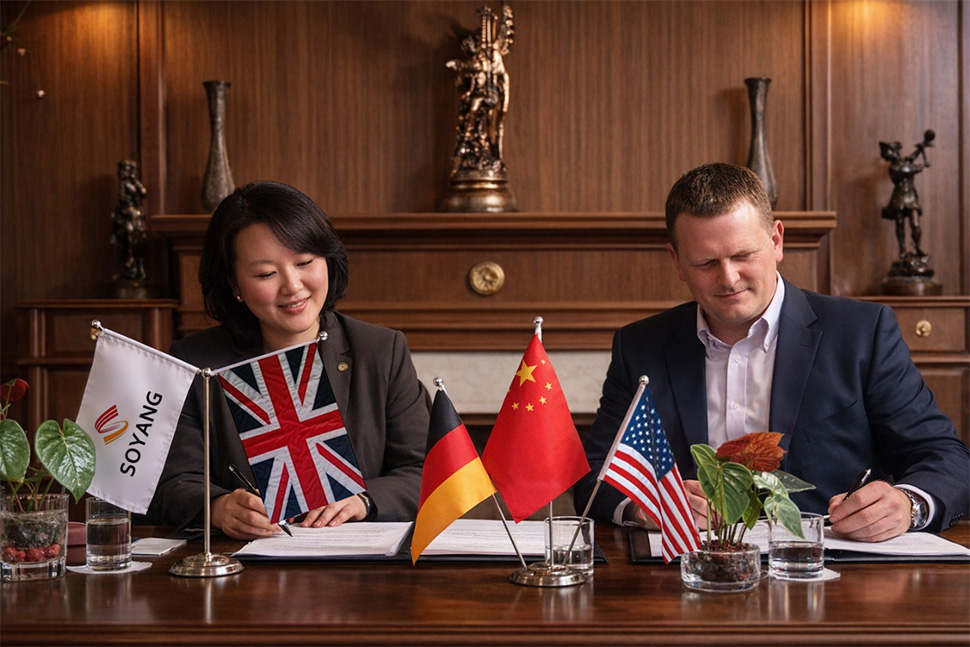
In 2005, Soyang Europe was established, beginning a pioneering Anglo-Chinese partnership long before such collaborations became commonplace.
Here in the UK, Soyang Europe is not an abstract Chinese factory with a website and a warehouse. It is a relationship. It is a Lancastrian family-led business that has spent more than twenty years building trust, continuity and accountability with customers who care less about slogans than about whether the roll turns up on time, behaves on the printer, and does not come back as part of a rejected job.
I am fairly sure at least part of the point of inviting me here was to reinforce exactly that: Soyang Europe as a trusted bridge between local relationships and global manufacturing strength.
A factory tour that didn’t feel like it was staged for my benefit
That sounds clever enough on paper. A factory is where clever ideas get tested.
The thing that surprised me most about the visit was how little of it felt staged. A lot of so-called factory tours are theatre. You get ushered through a polished meeting room, shown a presentation full of glossy imagery, grand claims and a wall of certification logos, maybe walked across a carefully selected patch of shop floor for ten minutes, then handed back to marketing before you can ask anything awkward.
Not here. Not today.
What I got instead was something much more persuasive: access to machinery, inspection points, the wet end of the process, coating lines, lab spaces, quality discussions, and the inescapable sense that the real religion here is not branding. It is quality control. Obsessive quality control.
That is what the shipping hall had hinted at, and what the rest of the day kept proving.
From raw material to printable media
To understand why, it helps to think about the journey a roll of media has to make before it is ready to be loaded onto a printer. Not every textile follows exactly the same route, but most large-format display fabrics follow the same industrial logic: start with raw material, engineer it into yarn, turn that yarn into fabric, then keep refining and controlling it until it behaves like application-specific print media instead of just cloth.
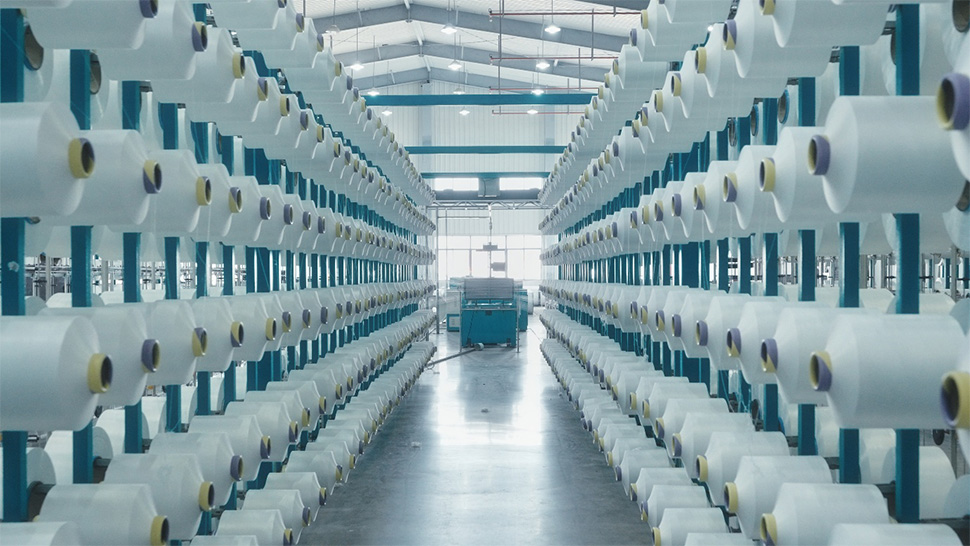
In Soyang’s raw-material warehouse, the yarns are stacked in plain view, which is useful because it lets you see the company’s priorities before a single machine starts moving. Alongside conventional polyester filament and textured yarns sit recycled PET yarns, SEAQUAL yarns made from ocean-recovered waste, and CiCLO yarns designed to biodegrade more like natural fibres. That is a quiet but telling reminder that sustainability, here, is not being bolted on at the end. It is being specified at the beginning.
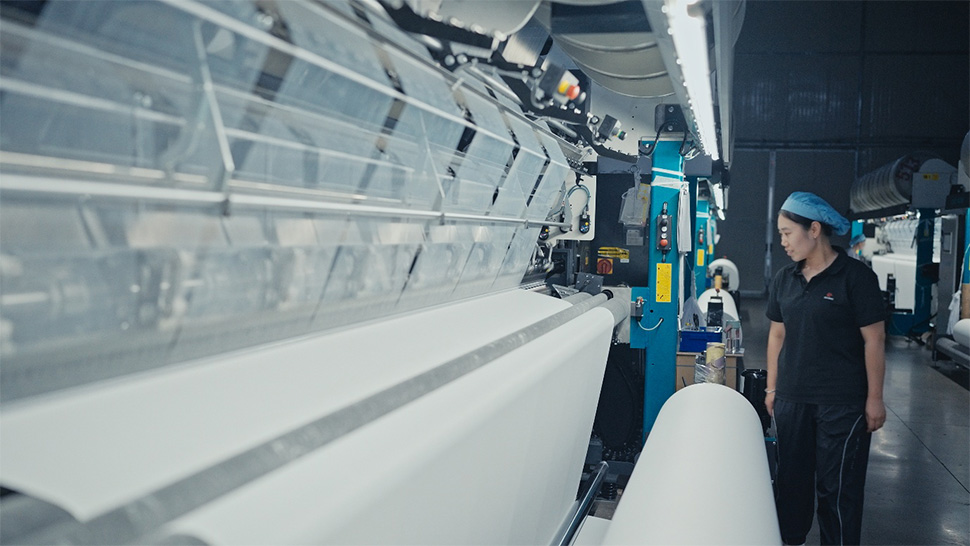
From there, the process moves the way you would expect a serious textile operation to move: the yarn is beamed under controlled tension, fed into knitting machines, and turned into fabric for applications like SEG, flags and stretch displays.
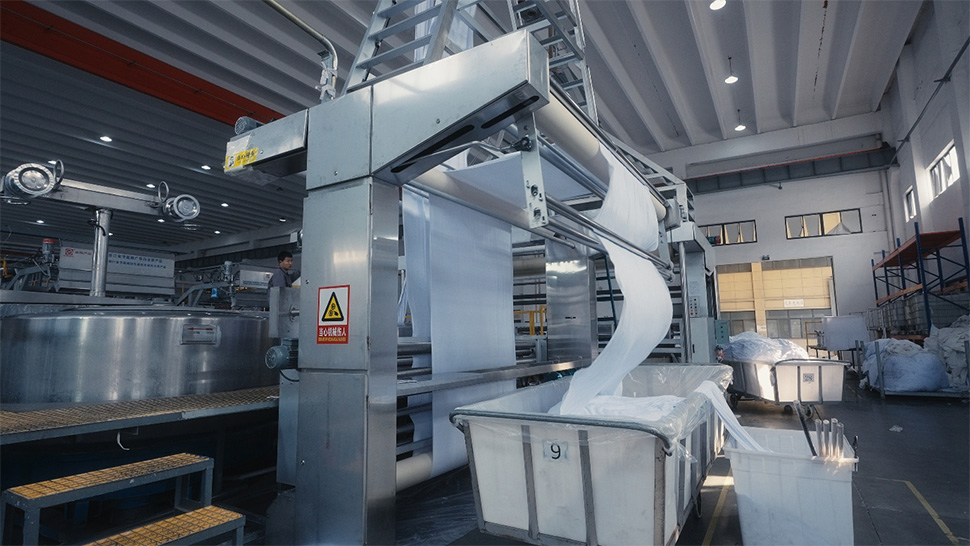
The fabric is then washed and prepared to remove oils, residues and process contamination.
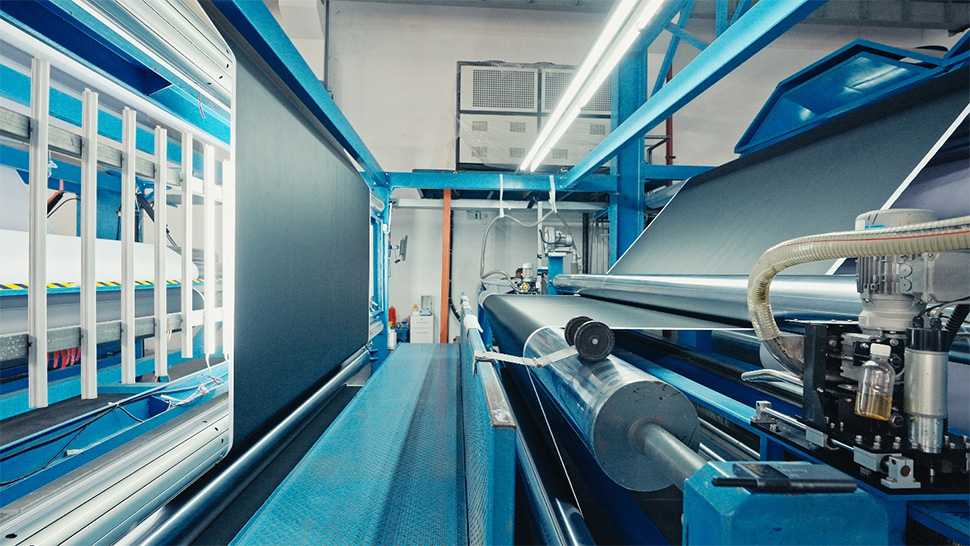
After that comes finishing, whether that means dip coating for softer, more permeable textiles where printability and dye-sub performance matter most, or knife coating for more engineered materials that need blockout, light diffusion, weather resistance or durability.
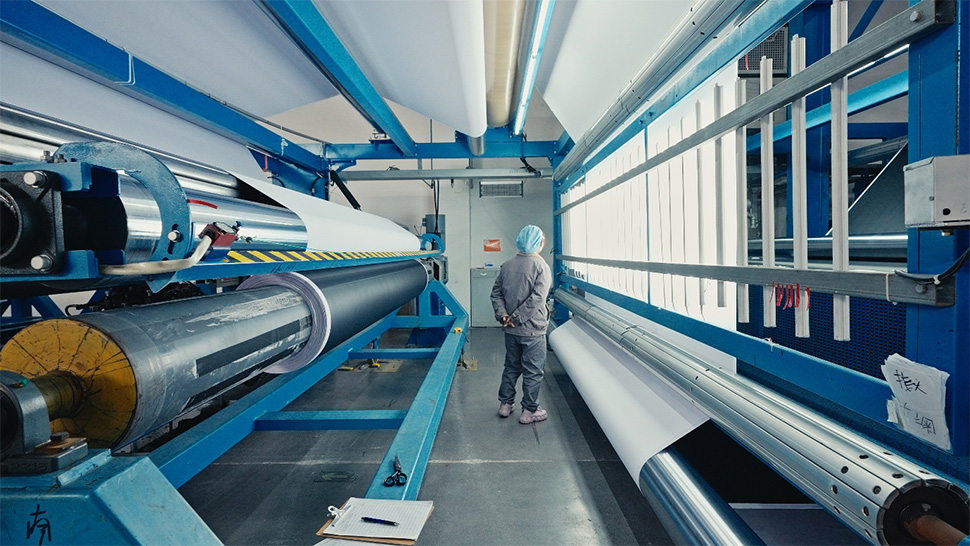
Once finished, the material is inspected, wound, converted into commercial roll sizes, labelled, wrapped and prepared for shipping.
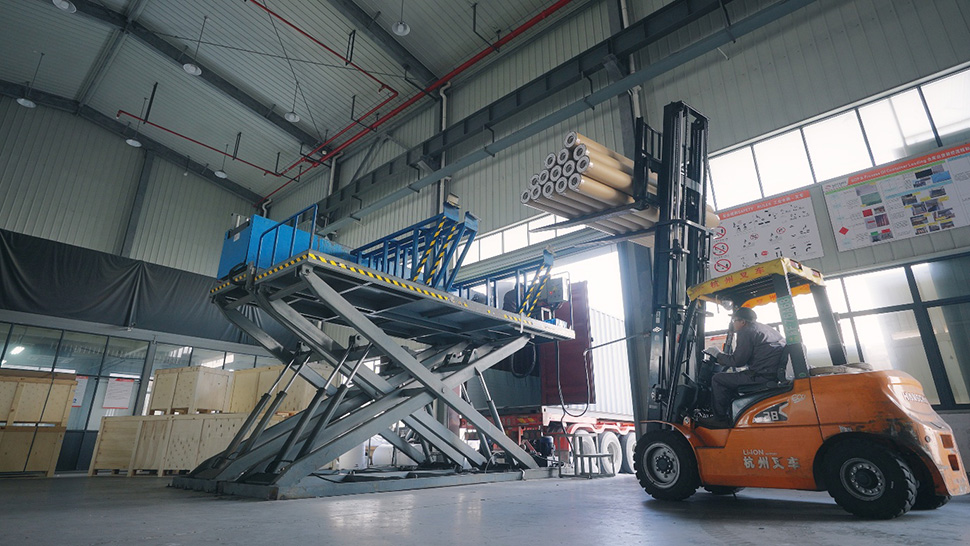
That is the real journey: from raw material to a roll of media engineered not merely to exist, but to behave impeccably on your printer.
Why quality control is the real story
And it only works if quality control is not something you bolt on at the end for the benefit of a brochure. Soyang’s testing runs from incoming raw materials to the finished packed rolls ready for dispatch, covering the things that actually matter once the media leaves the building: colour fastness, strength, flame retardancy, weather resistance and print performance. The point of all this is simple enough. Quality and compliance are not supposed to be lucky outcomes. They are supposed to be the result of a system.
Of course, that is the theory. What matters is whether the theory survives contact with reality.
From what I saw, it does.
In one part of the factory, I watched a wide web running through a coating line, a perfectly controlled sheet moving over rollers with that eerie mechanical calm you only get when tension, temperature and speed have all been bullied into cooperation.
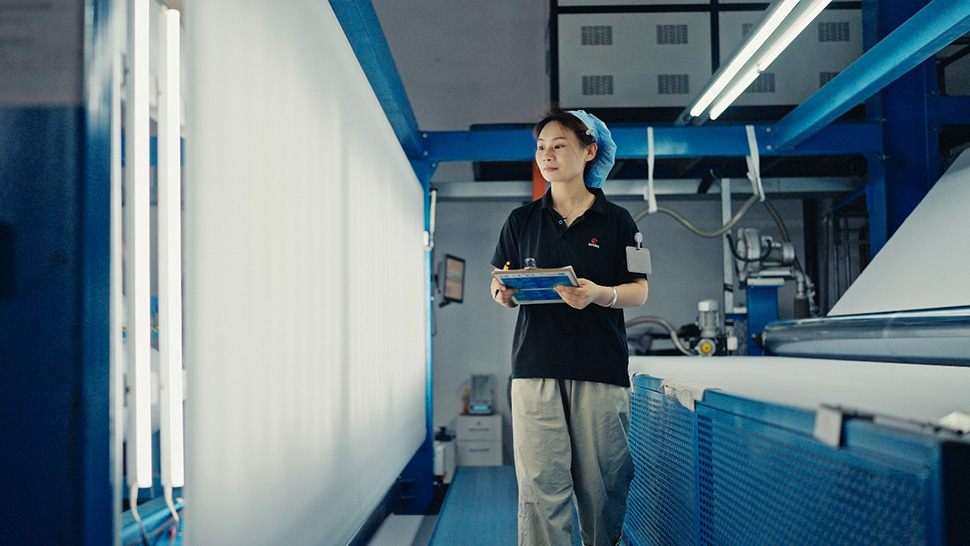
In another area, a member of staff stood with a clipboard in front of a moving wall of bright white textile, watching the surface under inspection lighting with the kind of focus print operators reserve for jobs that could become expensive in seconds.
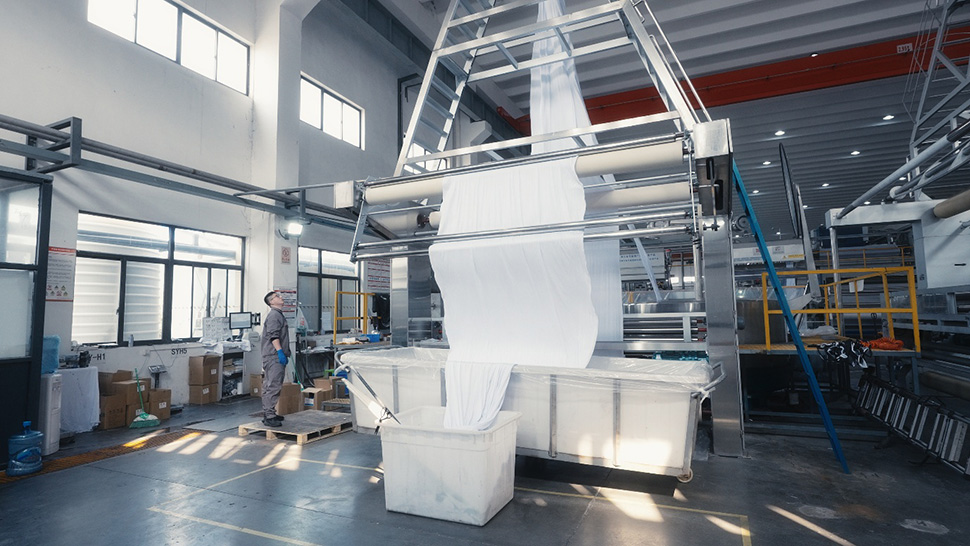
Elsewhere, material fed upward through banks of rollers in huge silent arcs, while in the wet-processing areas the mood changed again: piles of textile in carts, stainless machinery, pipes, valves, staff at the controls, and the unmistakable feel of real industrial work rather than presentation-grade manufacturing.
That is when the Soyang obsession with quality stopped being a corporate phrase and started looking like a workplace culture.
The company has spent years building towards a more integrated chain of warping, weaving, washing, dyeing, coating and R&D, with Karl Mayer warp-knitting equipment, open-width washing, 3.2-metre dipping and setting lines, and 5-metre coating capability. The benefit is not just capacity. It is control: stable temperature, even tension, fewer defects, improved surface uniformity, reduced shrinkage and greater consistency across wide-format digital textiles and coated materials.
Why this matters to print businesses
If you run large-format printers, you know exactly why that matters.
Nobody buying media for an HP Latex, a Mimaki or Roland eco-solvent, or a UV platform from swissQprint, Durst or EFI VUTEk is buying printable fabric in some abstract sense. They are buying reliable performance. They are buying feed stability, coating regularity, ink compatibility, dimensional consistency, finishing behaviour, installation predictability, and the right not to have an otherwise profitable job wrecked by a substrate deciding to play up halfway through production.
What the visit did was connect those claims to physical reality.
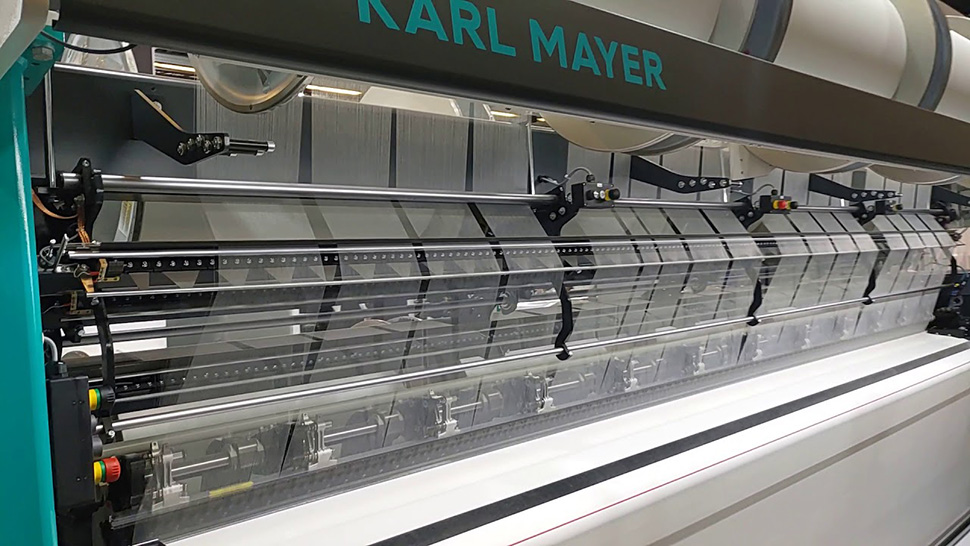
It is one thing to read that a manufacturer uses German-built Karl Mayer knitting systems and Menzel coating lines because they offer greater stability and fewer defects. It is another to stand in a place where the whole layout, from raw material onward, is designed to squeeze variation out of the process before the product ever reaches a printer. It is one thing to read that 3.2-metre and 5-metre coating lines rely on even tension and stable oven temperatures. It is another to watch a broad web of material pass through that environment and understand that these boring variables are where final print quality really begins, long before ink hits the surface.
The same applies to the laboratory.
Factories love to point at labs because laboratories look reassuringly scientific in brochures. But the useful question is not whether a lab exists. It is what the lab does in the chain of accountability. Here, the in-house laboratory supports product design, process validation and performance testing, and the QC structure is designed as a closed loop: in-line checks, random sampling, finished-product inspection, then third-party testing where needed. In other words, the system is built to keep catching problems until there are no excuses left for missing them.
Again, that was visible.
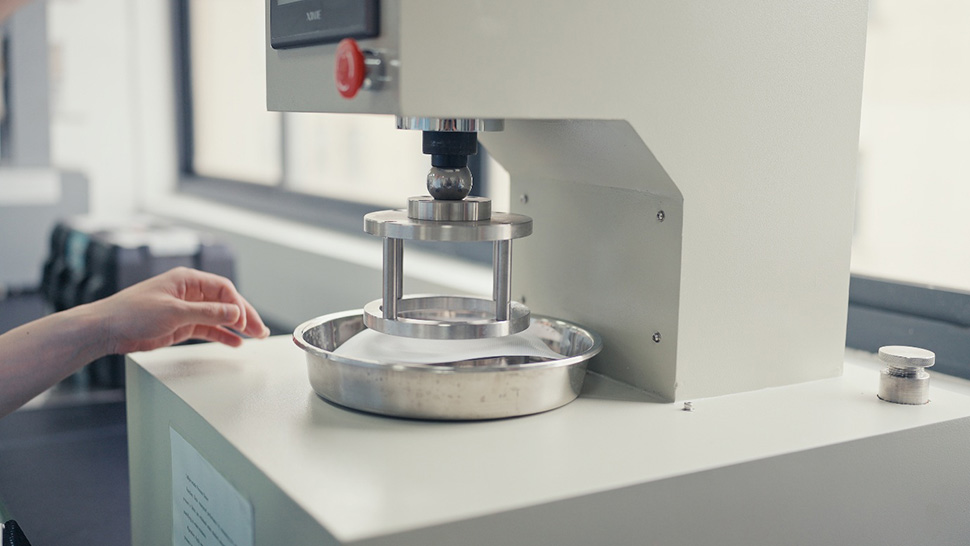
The photography from the tour shows test equipment, sample handling, bench instruments, and the kind of clean, methodical R&D environment where people are clearly measuring things because the wrong answer will cost money later. The real giveaway is that the people doing this work are not performing for visitors. They are just working. In one image, a pair of hands feeds a sample into a testing device with the practised efficiency that comes from doing the same job so often it becomes muscle memory. That is what quality looks like before marketing gets hold of it. Not a slogan. Just a stubborn refusal to trust any claim that has not survived contact with suitably fussy test equipment.
The bigger point about Chinese manufacturing
There is a deeper story here, and it is the one Soyang Europe is right to want this visit to tell.
For years, some buyers in Europe have treated Chinese manufacturing as though it were a synonym for inconsistency and risk. But once you have walked through the Soyang logistics centre, past the inspection points, into the wet-processing areas, through the coating and finishing environment, and into the lab, and once you have spoken not to marketing but to people in QC, R&D and engineering, that old caricature starts to look very flimsy indeed. What you are seeing is not a vague global supply chain. You are seeing a system that has spent years improving the variables that matter most.
Soyang’s own explanation of its market position makes sense in that context. Europe and America account for around 70% of its production because those markets demand exactly the things that are hardest to fake: stable quality, greener products, stronger application knowledge and constant innovation. To serve those markets, Soyang has pushed sustainability down into the operating system of the factory itself: wind power, rooftop solar, clean natural gas, heat recovery, low-nitrogen combustion and water recycling. It has also worked with SGS on product carbon-footprint accounting. The point is not that the factory has learned to say the right words about sustainability. It is that it is trying to engineer them into the process.
Of course that is the corporate version.
The human version is simpler.
Most of the people I saw barely noticed I was there. The language barrier was real, but it was not the main reason. The main reason was that they were busy. Busy checking. Busy watching. Busy measuring. Busy running lines. Busy installing equipment. Busy doing the very unglamorous work that allows somebody else, somewhere else, to load a roll into a printer and assume that the substrate will behave properly.
Which is why I came away from Soyang in China thinking less about branding and more about obsession.
Good factories are obsessive places. They are full of people who have learned, often the hard way, that quality is not a characteristic you announce. It is a discipline you enforce at every point where something could drift, warp, contaminate, vary, shrink, fail or otherwise disappoint.
The place has the mentality of a factory that knows exactly how much damage can be done by a little inconsistency.
If you run a sign, display or soft-signage business, you already know the dirty secret of print: the printing hardware gets the glamour, but the substrate gets the blame.
A roll goes skewy on the feed, a coated face behaves strangely under UV, a supposedly premium textile decides to shift, stretch, cockle, yellow, fray or shrink, and suddenly the RIP, the ink set, the head carriage, the room temperature, the finishing room and the on-site installer all end up in the dock. The media is never just media. It is the single biggest multiplier of everybody else’s problems.
That is the lens through which the Soyang philosophy makes sense.
I am glad I took the time to visit Soyang in China. It genuinely opened my eyes to how a modern factory can and should be run. Above all, it demonstrated that the most important shift in manufacturing is not from one country to another, but from one mindset to another: away from “make it cheaper” and towards “make it better.”
Having seen the process up close, I can say this much with some confidence: Soyang understands that quality is not what you claim at the end. It is what you control at every stage before the roll ever reaches the printer.
To read additional recent news from Soyang, click here