

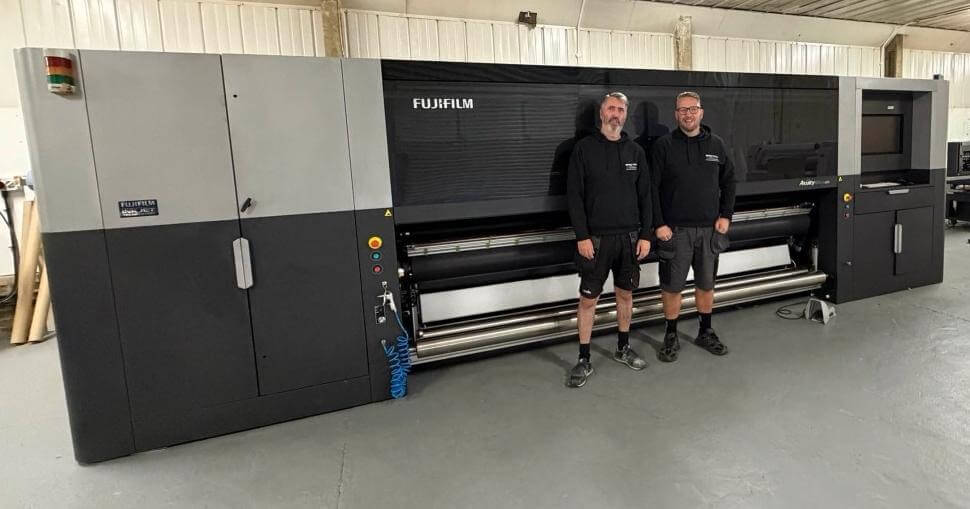
There is no shortage of independent engineers in wide-format, but Spectra Service Solutions is set to bring something a little different.
Set up by Marc Beresford and Adam Moore, the company starts with more than 40 years of combined industry experience, much of it spent working directly for OEMs. It also has something most independent service businesses do not: its own facility equipped with a Fujifilm Acuity Ultra and Acuity Prime.
That gives Spectra somewhere to reproduce faults, test solutions, train engineers and operators, work on applications and support demonstrations without experimenting on a customer’s production machine.
Its existing expertise covers the Fujifilm Acuity Ultra and Prime ranges, JHF and RTZ equipment, and Inca Onset hardware, including both engineering and applications support.
The timing is of course interesting. Fujifilm announced in 2026 that it would cease sales of new Acuity Prime and Acuity Ultra hardware as it refocused its print business. For existing owners, particularly those with substantial investments in Acuity equipment, that inevitably raised questions about what happens next.
Spectra’s answer is that rather less changes than customers might initially assume.
According to Marc and Adam, the original hardware manufacturers JHF and RTZ are now appointing new distributors, and have approached Spectra to provide technical support where appropriate. That started with the UK, but Spectra has since been asked to support installations internationally and provide second and third-line technical support in Europe, where time-zone coverage can otherwise become a problem.
Spectra can also continue to support existing Fujifilm installations, source spare parts and provide access to Fujifilm inks. For companies wanting additional hardware, Spectra says equivalent machines can be sourced directly from the original OEM manufacturers to the same specifications.
There is another side to the business too. Spectra wants to provide OEMs, distributors and resellers with experienced technical resource without requiring them to employ another engineer themselves.
Installation, servicing, breakdowns, training, applications, machine moves, belt changes, parts, printheads and colour management are all on the list.
We spoke to Marc and Adam about what they are building, Fujifilm’s change of direction and where Spectra fits.
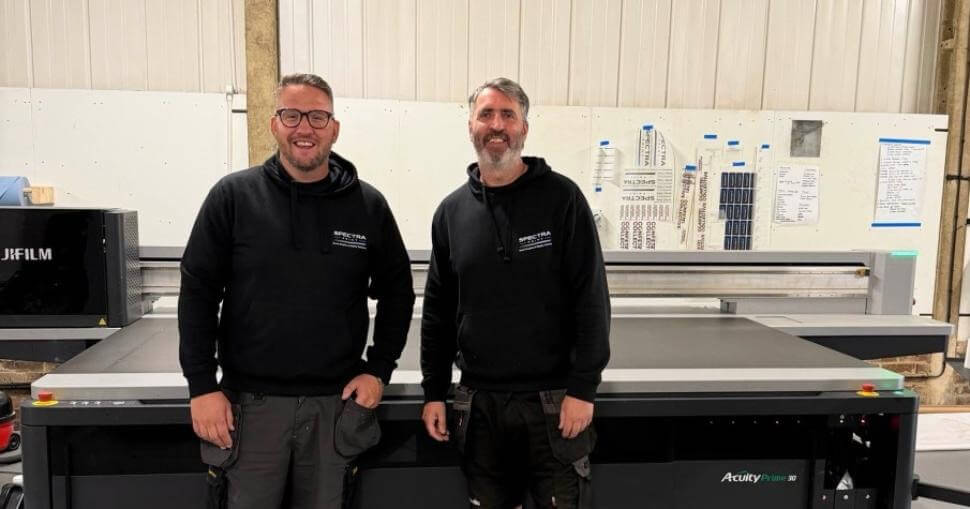
LFR: You have both spent a long time working on the OEM side of this industry. Why leave that and start Spectra?
Spectra: Between us we have more than 40 years in the industry, with a lot of that spent working directly for manufacturers. We felt there was room to take that experience and make it available differently.
There are customers who need experienced technical support but don’t necessarily need a conventional full service contract. At the same time, there are manufacturers, distributors and resellers that occasionally need more engineering resource than they have internally.
Spectra is flexible enough to assist with any of those options.
It might be one breakdown, an installation or a day’s training. It could equally be regular preventative maintenance or a service agreement covering a customer’s machines.
For a reseller, we could effectively provide the technical resource behind the hardware they sell.
LFR: That last part is interesting. You’re not positioning Spectra simply as an independent service company for end users?
Spectra: No. Direct support for print companies is an important part of it, but only one part.
We are looking at partnerships where we provide engineering resource to OEMs, distributors and resellers that don’t have their own coverage in a particular area.
Employing an engineer is a significant fixed cost, particularly when a distributor is building an installed base for a new machine range. We can give them access to somebody when they need one without them having to carry that fixed overhead from day one.
We can also act as second or third-line support behind a distributor’s own technical team when a problem goes beyond what can be dealt with locally.
That’s already led to discussions with OEMs and distributors about the machines themselves. We have worked with these products at OEM level and have been involved in developing equipment for western markets, so we know where the strengths are and where the machines have had to evolve.
We’re also prepared to learn new equipment where a reseller needs additional support. We don’t expect Spectra to be limited forever to the machines we already know.
LFR: Which machines can you support now?
Spectra: The Fujifilm Acuity Ultra and Acuity Prime ranges are a major part of our experience, along with JHF and RTZ equipment.
We can also provide expert service and applications support for Inca Onset and it’s subsequent Agfa derivatives.
Those are machines and technologies where we already have substantial experience. We’ve installed equipment, supported it in production, worked through faults and dealt with the issues that only tend to appear after a machine has been running commercially for some time.
That familiarity matters when something goes wrong.
LFR: The Fujifilm situation has changed quite substantially since you began planning Spectra. Fujifilm has now stopped selling new Acuity Prime and Ultra hardware. What does that mean for existing customers?
Spectra: We understand why customers might initially be concerned, particularly if they have invested heavily in Fujifilm equipment.
From a practical service and support point of view, though, very little needs to change.
We know the machines. The original OEM manufacturers know the machines. We have spare parts available from stock, Fujifilm ink remains available, and we can provide the engineering and applications knowledge needed to keep the equipment running.
The Fujifilm badge disappearing from new hardware sales doesn’t suddenly make all of the existing machines obsolete.
LFR: And the original manufacturers behind the Fujifilm hardware were JHF and RTZ?
Spectra: Yes. JHF and RTZ were the OEM hardware suppliers behind these Fujifilm platforms.
Since Fujifilm announced its change of direction, both companies are moving to broader distribution and have already approached us about providing technical support in the UK.
That conversation has already gone further. We’ve since been asked to provide support internationally, particularly for installations, and to act as second and third-line technical support for Europe. Time zones matter when a distributor has a difficult problem and the factory engineering team is several hours ahead.
We can sit between the local distributor and the OEM when that extra level of technical experience is needed.
That’s a natural fit for us because we already know the equipment.
LFR: So if somebody has an Acuity now and wants another machine, where previously you might have introduced them to Fujifilm, what happens today?
Spectra: We can put them directly in contact with the original OEM.
The important point for an existing user is that the underlying equipment hasn’t suddenly disappeared because Fujifilm has stopped selling it.
JHF and RTZ can supply new hardware to the same specifications, and customers can continue using Fujifilm ink.
Spectra can then provide the installation, commissioning, operator training, servicing, spare parts, applications advice and ongoing technical support.
From the customer’s point of view, most of the things that actually matter remain in place.
The main difference is where the machine is purchased.
LFR: There could actually be a commercial upside to that?
Spectra: Yes. That’s one of the things we want existing Fujifilm customers to understand.
They shouldn’t look at the Fujifilm announcement and assume they have suddenly been left with unsupported equipment or that there is no route to adding another machine.
There is.
The hardware manufacturer is still there, the parts are still there, the ink is still there and the technical knowledge is still there.
LFR: In simple terms then, your message to an Acuity customer worried by Fujifilm’s withdrawal from hardware sales is that not very much actually changes?
Spectra: Exactly.
The route to buying a new machine changes.
The people who manufactured the hardware are still manufacturing equipment. Fujifilm ink remains available. Spectra can provide the service, applications support, training and parts support.
For somebody running an existing installation, the machine doesn’t know that the sales structure above it has changed.
Our job is to make sure the customer doesn’t feel that change operationally either.
LFR: You’ve got an Acuity Ultra and Prime at your own facility. Why go to the expense of having the actual machines there?
Spectra: Because there are things you can do properly when you have access to the machine that are much harder to do remotely or at a customer site.
If somebody has an unusual problem, we can try to reproduce it. We can test settings, media or possible solutions without interfering with their production.
Training is another big reason.
Trying to train an operator on a machine while the production manager is waiting to get it back isn’t ideal for anybody. At our facility we can spend the time needed and let people work hands-on with the equipment.
The same applies to engineer training.
LFR: Presumably that also takes Spectra well beyond mechanical servicing?
Spectra: Very much so.
We have applications experience as well as engineering experience, so we can help with materials, machine settings and colour management.
Not every print problem is a broken component.
Sometimes the machine is doing exactly what it has been told to do, but the media, profile or settings aren’t right for the application. Being able to look at that side of production as well as the engineering side is important.
Having machines at our own facility also means we can test things rather than asking a customer to keep making changes on a live production printer.
LFR: Is that applications capability available to Inca Onset users as well?
Spectra: Yes.
We can provide expert engineering and applications support for Inca Onset hardware.
That can include fault finding and servicing, but also helping customers with the practical production side of running the equipment.
There are plenty of Onsets still producing a lot of work. Experienced technical and applications knowledge for those machines still has value.
LFR: What happens when a customer actually has a machine down?
Spectra: The first step can be remote fault finding.
If we can diagnose the problem remotely and safely get the customer running again, that’s obviously the quickest answer.
Where an engineer is required, we can go to site.
We can deal with breakdowns, servicing, preventative maintenance and general machine health checks, as well as larger jobs such as belt changes.
The aim is to get to the cause of the problem rather than automatically turning every fault into an engineer visit.
LFR: And installations?
Spectra: Yes. We can install and commission machines, decommission them and handle machine moves.
We can also train the operators once the machine is installed.
Installations are already becoming part of the international side of the business as well. JHF and RTZ originally approached us about UK support, but we have since been asked to support installations in other markets.
That makes sense for the OEM and the distributor. They can bring in people who already know the equipment rather than starting again every time a machine crosses a border.
LFR: You’ve mentioned preventative maintenance a few times. Do you expect Spectra to be as much about keeping machines healthy as repairing them when they stop?
Spectra: Yes.
We can provide annual servicing and preventative maintenance, and carry out machine health checks to identify things that need attention before they become bigger problems.
Customers will want different levels of support.
Some will only call us when they have a problem. Others will want servicing scheduled throughout the year. Some may want a full service agreement.
We’re happy to work either way.
LFR: Parts can become a painful subject once wide-format machines get older. Can you help there as well?
Spectra: Yes, and we don’t want parts support to mean waiting while something works its way through several layers of supply.
We will be supplying spare parts directly to the market at competitive prices and holding stock at our own facility.
For commonly required parts, that should give us much quicker turnaround when a customer has a machine down.
We also have direct contacts with OEMs and suppliers, so where something isn’t in stock we can identify exactly what is required and source it through the appropriate route.
That becomes particularly relevant now for Fujifilm customers who may be wondering what happens to parts availability following the decision to stop selling the hardware.
Our message is simple. Talk to us before assuming something is unavailable.
LFR: How does Fujifilm fit into the picture now? Presumably Spectra’s relationship with the company doesn’t simply disappear because Fujifilm has stopped selling the printers?
Spectra: No.
We have both spent a long time around Fujifilm equipment and people, and Fujifilm remains important because customers are still running its ink and a substantial installed base of its wide-format equipment remains in production.
We’re interested in continuity.
Our focus is making sure those customers still have access to people who understand their machines and applications.
There is no benefit to anybody in good equipment becoming difficult to support simply because the commercial route to market has changed.
LFR: You can also support OEM demonstrations. What would Spectra actually do in that situation?
Spectra: It depends on what the OEM needs.
We can support demonstrations using the machines at our facility, work alongside an OEM at its own premises, or provide support in a distributor’s demonstration room.
That could include operating the equipment, setting up applications, advising on materials or helping get the machine configured correctly for what the customer wants to see.
We’ve both spent a lot of time around customers looking at equipment before they buy it. A good demonstration needs somebody who understands both the machine and the application.
LFR: Colour management and applications support could become quite a substantial part of the business in its own right. Is that the intention?
Spectra: Yes.
A customer can have a perfectly serviceable printer and still be struggling with a particular material, application or colour requirement.
We can help with material choice, machine settings, colour management and getting the best result from the equipment they already own.
The facility helps here as well because we can run tests on our own machines.
That is particularly useful when a customer wants to try something different but doesn’t want to lose production time finding out whether it works.
LFR: How geographically limited are you?
Spectra: We aren’t limiting ourselves to the UK.
JHF and RTZ first approached us about UK support, but the requirement has already expanded into international installations and European second and third-line support.
We can also provide remote support globally and travel where on-site support is required.
We’ve both worked internationally before, so that side of the job isn’t new to us.
For some problems the geography barely matters. For others, somebody needs to be standing next to the machine.
We can do both.
LFR: Where do you think the biggest opportunity is? Directly with printers, or becoming the technical resource behind manufacturers and distributors?
Spectra: We think there is room for both.
Print companies want access to people who know their machines and can get them running again.
The reseller and OEM opportunity is different. There are companies that want to sell more equipment or enter new territories but don’t necessarily want another full-time engineer on the payroll before the installed base supports one.
We can also sit behind an existing distributor service team as second or third-line support when they hit something they can’t resolve themselves.
Our work with the OEM products goes further than servicing them. We’ve been involved in developing machines suitable for western markets, so we can also talk to distributors about where the products are strong and how they fit the market.
The discussions with JHF and RTZ are a good example of how the model can work. They sell the equipment and Spectra provides another layer of technical and applications resource behind it.
LFR: Does that risk Spectra becoming invisible? You could end up doing the work while somebody else’s name remains on the customer relationship.
Spectra: That’s fine.
If we’re working on behalf of a reseller or OEM, our job is to support that relationship properly.
Spectra doesn’t need to own every customer.
The important thing is that the machine gets installed correctly, the operators know how to use it and somebody competent is available when it needs support.
If that means working in the background for one customer and directly with another, that’s part of being flexible.
LFR: What would you like Spectra to look like a couple of years from now?
Spectra: We want to build a strong service and applications business with a reputation for knowing the equipment properly and doing the job properly.
We expect the range of machines we support to grow, particularly where manufacturers and resellers need extra technical coverage.
But we don’t want to grow by promising support on equipment we don’t understand.
If we take on another manufacturer’s machines, we’ll learn them properly first.
That’s important to us.
LFR: You’ve used the phrase “same expert service, different brand”. Does Fujifilm’s decision make that line rather more literal than you originally intended?
Spectra: Probably. For an existing customer, that’s essentially what we’re offering.
The badge on the engineer’s shirt changes.
The route to buying another machine may change.
The knowledge of the equipment is the constant.