
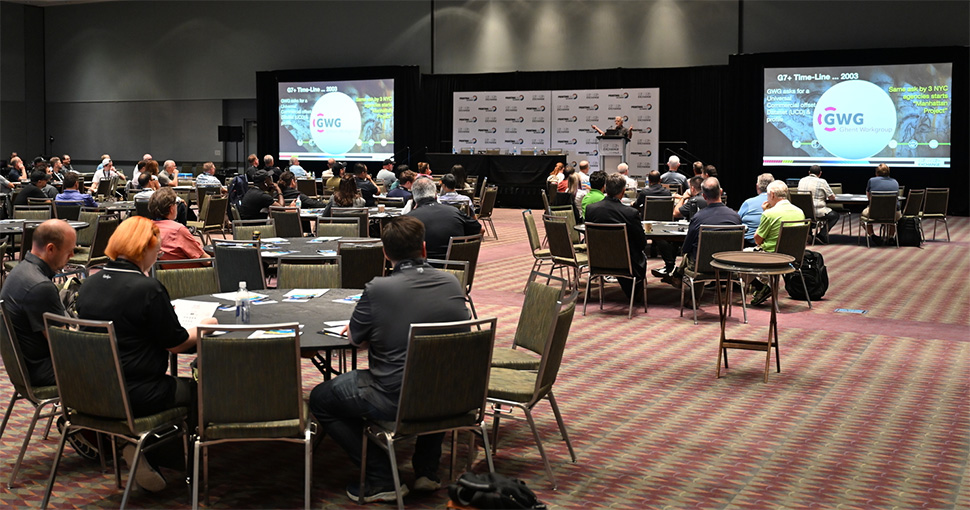
The G7/G7+ Exchange, hosted by PRINTING United Alliance at PRINTING United Expo 2025, took place on Tuesday 21st October at the Orange County Convention Center, Orlando, Florida. The free-to-attend four-hour deep dive into colour management was open to all attendees and was supported by Heidelberg as Platinum Sponsor, alongside Agfa, Barbieri, Canon, Lithec USA, Ricoh, and Techkon.
The event brought together hundreds of colour management professionals, printers, and curious newcomers to explore developments in G7 and G7+ standards, as well as learn from real-world examples and gain practical tips and advice on G7/G7+ implementation.
Key Takeaways:
- The G7/G7+ Exchange marked the first in-person G7-focused event since 2017 and the first to spotlight G7+, the updated iteration of the colour calibration methodology which launched in January 2024
- G7+ introduces an enhanced algorithm, improved tonality control, and wider compatibility across print processes and substrates
- Over 500 G7+ Experts have been certified globally. System certification for G7+ began in November 2025, with the G7+ Master programme due to launch in early 2026
- Colour management experts and print professionals shared practical case studies demonstrating G7+’s relevance across digital, flexo, inkjet, and DTF applications
- Collaboration and communication between brand owners, designers, and print providers remain central to achieving consistent colour outcomes
Opening Session: Focus on Consistency and Collaboration
The G7/G7+ Exchange opened with warm welcomes from David Leskusky, President of PRINTING United Alliance, and Joe Marin, Senior Vice President of Member Services at PRINTING United Alliance.
Marin set the tone for the afternoon, expressing his hope that the event would “spark ideas and strengthen connections in the community”. He also noted that “when colour goes wrong, everybody notices. When it goes right, everybody sleeps at night,” adding that the Exchange was particularly significant as the first in-person G7 event since 2017 and the first ever with G7+ as the central focus.
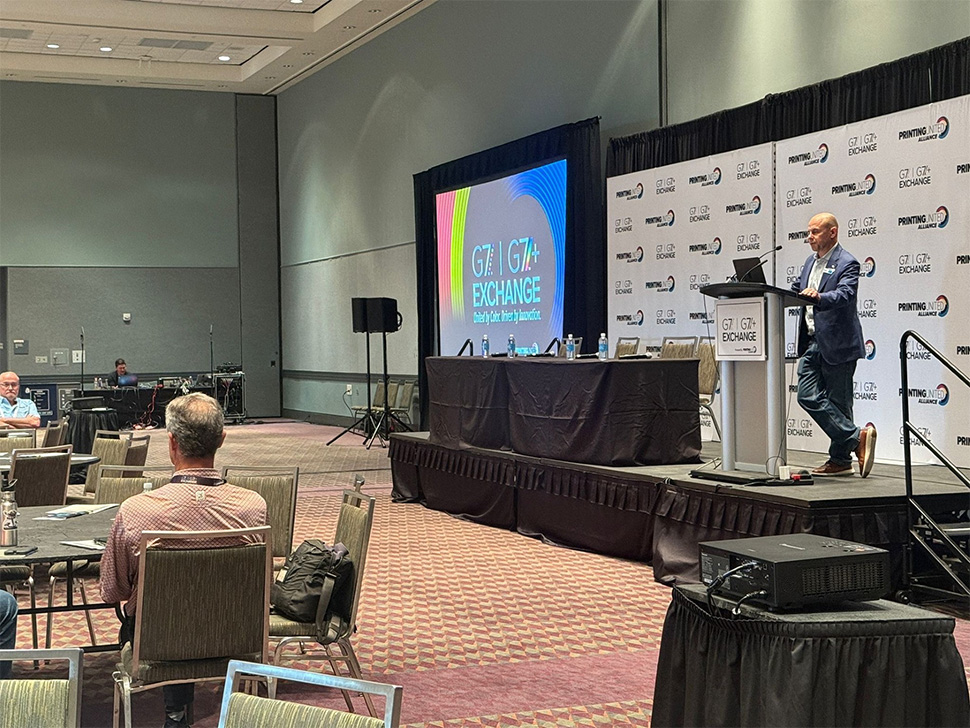
David Leskusky, President of PRINTING United Alliance welcomed attendees to the G7/G7+ Exchange
He highlighted that G7 Master Facility certification – achieved when a Certified G7+ Expert conducts and reviews a facility’s calibration data in order to grant G7+ Master Facility Certification by PRINTING United Alliance – remains a key differentiator for printers, offering assurance of predictable and consistent colour reproduction for brand owners.
Marin concluded that the goal of the day was “connecting, being together, and learning,” particularly as print applications expand and the colour spectrum continues to evolve.
Don Hutcheson on G7’s evolution to G7+
First up Don Hutcheson, developer of the G7 methodology, presented a detailed account of the colour management standard’s evolution. G7 originated from his early work on grayscale calibration in the late 1970s, progressing through the GRACoL and Ghent Workgroup (GWG) collaborations in the early 2000s, which established a universal dataset for offset printing.
Since then, G7 has been adopted globally for its simplicity and efficiency, aligning multiple printing systems through consistent tonality and grey balance rather than ink colour control. Hutcheson explained that this shared “neutral appearance” has been fundamental to its widespread uptake.
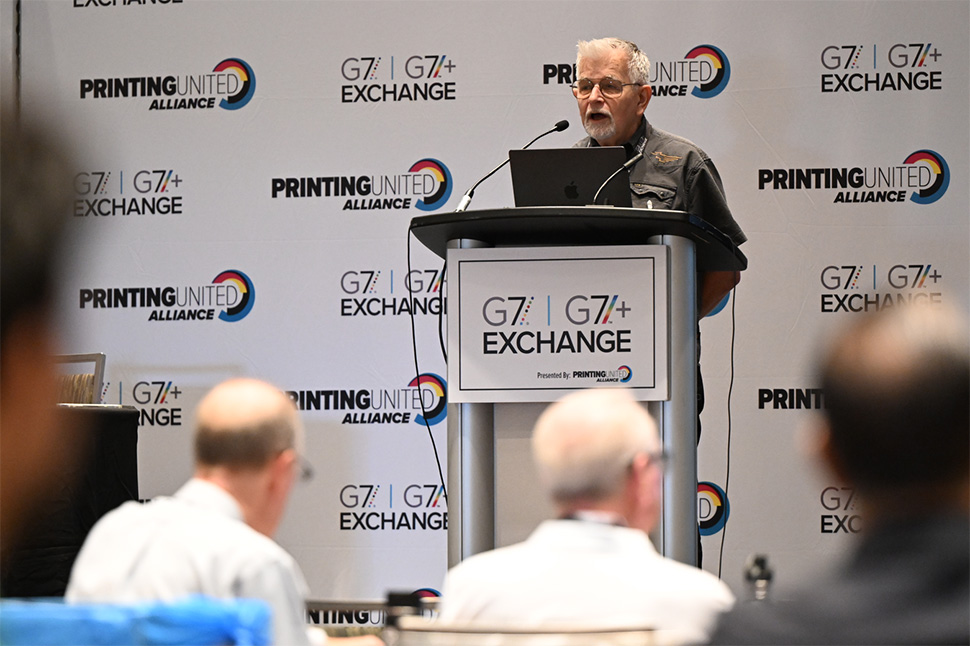
Don Hutcheson, developer of the G7 methodology
The introduction of G7+ in January 2024 by PRINTING United Alliance represented a significant step forward. The new tonality algorithm offers broader process compatibility, enhanced tonality control, and a more visually neutral appearance across diverse substrates, including coloured and synthetic materials. The addition of High Density Smoothing helps eliminate potential banding during calibration.
With already more than 500 G7+ Experts certified by PRINTING United Alliance, Hutcheson confirmed that system certification for G7+ began in November 2025, with six systems already preparing to apply. A G7+ Master programme will follow in early 2026. He also noted that G7’s inclusion in the ISO near-neutral framework is expected to be ratified in 2026, providing an alternative to the traditional Tone Value Increase (TVI) approach, to support the established usage of G7 around the world driving visual consistency and efficiency throughout the print supply chain.
Real world applications: Taylor Corp and ColorCasters
The afternoon then moved into practical case studies, beginning with Jeff Thielsen, Senior Production Engineer and Analyst at Taylor Corporation, who demonstrated how the company applies G7 across its 50 printing facilities, spanning everything from flexo and inkjet to packaging, using G7 calibration and colour management workflows to ensure uniform results across all processes and materials. More than 150 employees are now G7 trained, reinforcing its position as a trusted partner for brand-critical printing.
Jim Raffel, CEO of ColorCasters, followed with a presentation on using G7+ for Direct-to-Film (DTF) printing, addressing challenges with layering white ink over process inks. Through G7+ calibration and ICC profiling, ColorCasters has achieved greater stability and repeatability across RIP software platforms, proving that G7+ truly works on everything, from textiles to specialty applications.
Roundtable discussions: From gray balance to wide-format challenges
Attendees then took part in ‘choose-your-session’ roundtable discussions with the Wide-Format Inkjet and G7+ session drawing in the biggest audience, followed by Simplicity in Gray Balance and Substrate Correction.
During a G7+ Toolkit breakout led by Shelby, attendees, many new to colour management, were reminded that “if the grey shifts, the colour shifts.” Shelby underscored the importance of selecting RIPs that support G7 calibration, such as Fiery, Caldera, and Onyx, and noted that consistency, not “matching”, is the goal. The conversation highlighted the everyday challenges of managing multiple devices, substrates, and RIP environments, particularly for smaller businesses and DTF startups using unfamiliar software from overseas.
Aligning creative and production for designers and brands
Bringing a creative perspective, Andy Bullock of Spanner addressed the communication gap between designers and printers, outlining how colour consistency begins long before the file reaches the press and highlighting how establishing uniform RGB and CMYK profiles across design workflows helps to reduce errors during print production.
Bullock stated that “G7 only really works for creatives if everyone is striving for the same results,” adding that when designers understand the limitations and possibilities of print colour, makeready times and costs are significantly reduced.
Practical lessons: Insights from Ron Ellis
Ron Ellis of Ron Ellis Consulting shared ten practical lessons from two decades of G7 training, stressing the need for stable press conditions, accurate measurement, correct curve selection, and operator awareness. He also noted that lighting, paper quality, and scheduling can all affect calibration outcomes, reinforcing the value of disciplined process control.
Closing panel: Bridging brand, design, and print
The day concluded with a panel moderated by Jordan Gorski VP, Global Standards and Certifications at PRINTING United Alliance, featuring Paul Happ, Principal Consultant at Ricoh; Mike Todryk, Manager, Color Technical Support at IWCO; Tim Quinn Consultant at Nazdar; and Peter Possenti, Image Specialist, Prepress at Mammoth Brands.
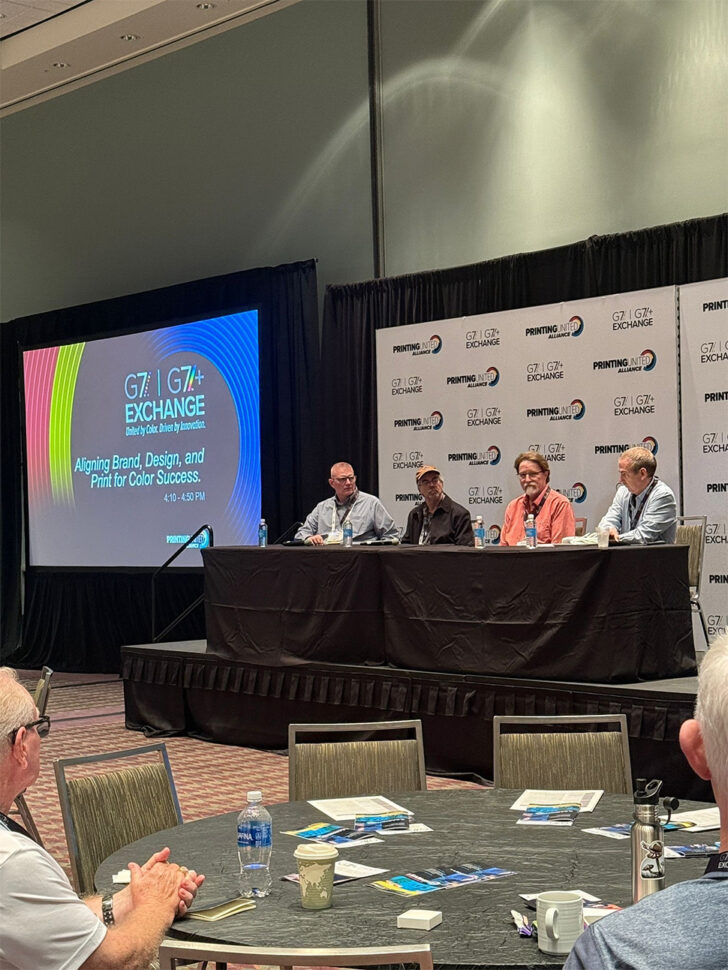
The discussion centred on improving education and communication between brands, designers, and printers; and speakers noted that misunderstanding around spot colours, CMYK expectations, and screen-to-print conversion continues to cause challenges. As Possenti summarised, effective colour alignment begins with “communicating expectations, sharing data, and understanding tolerances.”
The panel agreed that while technology enables standardisation, collaboration and shared education are essential to consistent brand colour across global supply chains.
A uniform standard of colour management, globally
The G7/G7+ Exchange underscored the continued importance of standardised colour management across the expanding landscape of print technology across both printing machines and substrates. With the established and growing network of G7+ Experts and additional forthcoming G7+ certification programs, along with G7 integration into ISO standards, the methodology appears well positioned to continue to serve as a flexible, process-agnostic approach to achieving colour accuracy and consistency across print and digital platforms globally.
For more information about G7/G7+ certification, visit: https://www.printing.org/library/technical-excellence/certifications/g7plus