

While hardware remains crucial in large-format print, success increasingly depends on the software and systems behind it. LFR sat down with Daniel Martinez, Senior Vice President and Division President for HP Large-Format Print, to discuss why workflow digitisation is becoming critical across the sector.
With exhibition season edging ever closer, manufacturers around the world are preparing to show off their latest machines to the market. Whether we are talking worldwide events like the FESPA Global Print Expo or PRINTING United, or smaller events that are tailored to regional crowds, there is plenty to get excited about in terms of new hardware.
However, while the actual printer is a critically important element of any production set-up, large-format or otherwise, it is crucial for print companies not to lose sight of the bigger picture and the other elements that go into making their business a success in what is a competitive, modern market – particularly, software.
Large-format print has taken huge leaps forward in terms of software. The solutions and products now available to customers not only make day-to-day life easier in production settings but also open doors to them in regard to new opportunities and accessing additional revenue streams.
The fact is that the winners and success stories in large-format print – no matter where on the planet the print company is based – will not be the shops with the best hardware, but those that also digitise and automate the entire workflow to support wider operations.
LFR recently spoke with Daniel Martinez, Senior Vice President and Division President for HP Large-Format Print, to find out more about the increasingly important role that software is playing within this market and how integrating these solutions into your workflow will set you up for long-term success.
Why workflow digitisation matters in large-format print
For Daniel, software is no longer a “nice to have” add-on to production. Instead, it is becoming the difference between businesses that can scale sustainably and those that remain stuck in labour-heavy, manual processes that limit growth.
In many large-format print environments, productivity is not held back by print speed or even capacity on the shop floor. Instead, the biggest bottlenecks often appear before a job ever reaches the printer. This could be how files are received and preflighted, how approvals are managed, or how the print company schedules work across devices including finishing.
While on the surface these tasks may not appear to be the most complicated, the reality is that they can be deceptively time-consuming, especially as print jobs become more complex and customer expectations around turnaround continue to tighten. Simply put, the more manual touchpoints that are involved, the greater the chance of errors creeping in – and over time, this friction can eat into margins and limit how much work a business can take on.
Daniel said that this is where software can have the most impact and support simple yet common problems such as file version issues, incorrect sizing, last-minute amendments not being picked up, or a job being sent to print without the right settings.
“Ultimately, it comes down to digitisation of workflow,” Daniel said. “Being able to spend time on ensuring the output of what printers are producing is of the highest quality, and less time on back and forth with the customer, ramping up or training their operators, and on managing files and sending files through the RIP to the device — which takes a lot of time, especially for larger jobs – all helps.
“A lot of what we’re focused on at HP is removing friction and effort from that entire process so that a print service provider (PSP) can focus on growing the business, keeping their customers happy, and ultimately looking for new customers.”
Using digital workflows to stay competitive in print
For many large-format print companies, digitising workflow is not just a matter of making life easier on the shop floor. The reality is that it can fundamentally change how a company competes. With order volumes fluctuating and customer expectations rising, having the ability to adapt quickly is becoming just as important as the quality of the final output.
Daniel said many PSPs are still relying on manual processes or disconnected systems that make it difficult to keep a clear view of operations in real time. He said some companies still operate with a “pen-and-paper” approach, making management of production tricky for workers. Even for those with some sort of software in place, they use generic workflow solutions or project management tools, which limit insight into overall production and prevent users from improving operations.
The challenge, he added, is that limited visibility often translates into time lost trying to understand where costs are coming from and where profit is being made.
“What we’ve seen through our research is that a lot of PSPs don’t really have a very detailed account of their costs and ultimately where profit is coming from,” Daniel said. “Digitising workflow can help PSPs understand their profit drivers and manage cost and profit management, giving greater visibility across the end-to-end workflow from order creation, all the way to production and installation.”
Such is Daniel’s confidence in this that he views digital workflows and data-driven operations as the next major leap in large-format printing, saying both will help PSPs make better decisions without adding unnecessary admin – allowing companies to focus on what they do best, creating print.
“We’re betting on digital workflows because of all the advantages that it brings,” he said. “This is not just from driving more efficiency but by being able to adapt better to demand, whether that is growing demand or slower demand, as well as to help PSPs to manage and grow their operations profitably through the use of intelligence and data in a way that doesn’t require them to spend hours at the end of every day putting numbers into a spreadsheet.”
Building an ecosystem around the printer
Rather than viewing workflow tools as separate add-ons, Daniel said that the primary goal for HP is to build an ecosystem that helps PSPs connect the steps around production, from managing files and queues to keeping track of jobs and reducing manual touchpoints that can slow teams down.
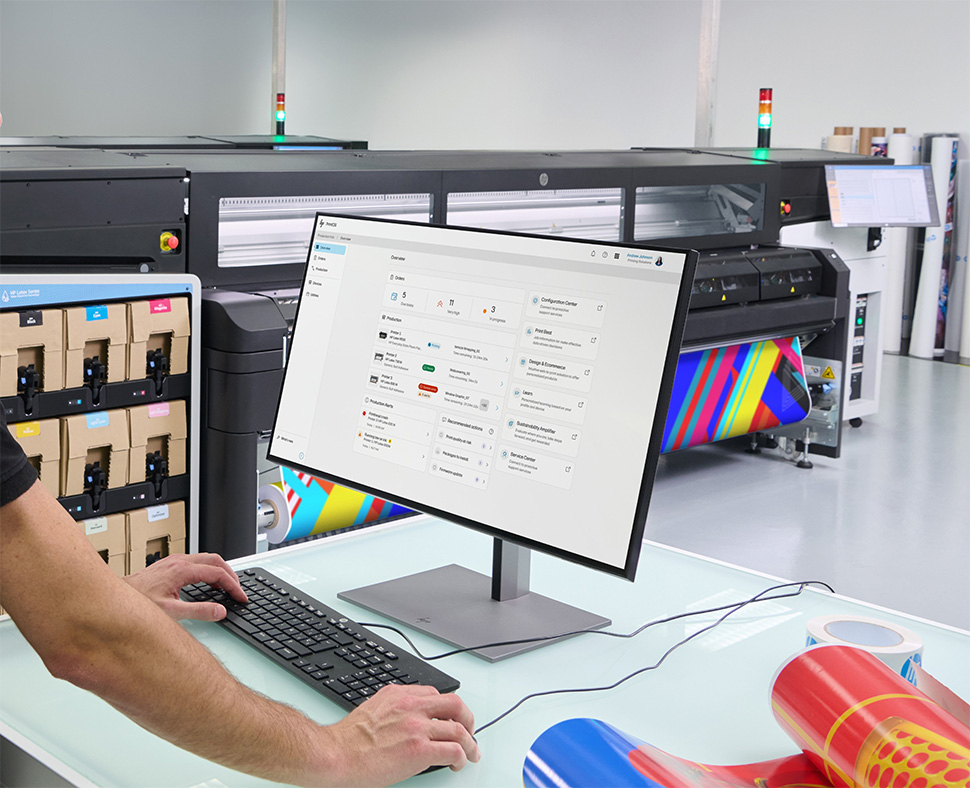
An important part of this ecosystem is HP PrintOS Production Hub, HP’s platform designed to centralise order management and production control for large-format print operations. By bringing job management and remote production oversight into a single, real-time environment, it is intended to help PSPs reduce operational complexity and improve efficiency across their business.
With clearer visibility of jobs and production activity in one place, HP PrintOS Production Hub supports more consistent operations, helps teams respond more quickly to changing priorities and reduces the risk of errors and bottlenecks that can slow production.
On the web-to-print side, HP PrintOS is designed to complement online ordering and MIS/workflow systems, helping bridge the gap between order intake and production. Job data from web-to-print storefronts and connected workflow tools can flow into the PrintOS environment, reducing manual job handling steps and improving accuracy in how work is scheduled and produced. For PSPs planning to handle higher volumes of shorter-run jobs, this connection between front-end ordering and back-end production becomes increasingly important.

Using AI to automate workflows in large-format printing
Daniel added that HP is looking to make greater use of artificial intelligence, or AI, to support its current digital offering and help develop any future launches to further support users around the world. He said AI will play an increasingly important role in making workflow digitisation more achievable for PSPs, particularly when it comes to reducing the manual steps that slow production down.
“So, a lot of those steps we think can be automated,” he said. “We’re applying AI to solving a lot of those issues. A PSP doesn’t have to spend hours on the phone and editing jobs, but they receive them already in a format, in a resolution that’s ready for production.”
On this, Daniel said automation of this type will become increasingly important for print companies in the large-format sector. He added that this shift will not simply be about speed for speed’s sake, but about building greater resilience into day-to-day operations, particularly when demand rises suddenly or when jobs become more complex and more time-sensitive.
“Those PSPs that adopt more digital technologies and more digital workflows will be better prepared for any changes or fluctuations in demand,” Daniel said. “Having that automation becomes more and more critical because you’re able to accept more jobs with the same level of cost.”
How digital workflows unlock new growth in print
Of course, while much of the focus of digitisation and automation is on improvements in-house, the reality is that making these changes will have a positive impact on the wider print business. This includes the number of customers you work with and the volume and type of work you can take on from both new and existing clients.
As Daniel mentioned, a stronger, in-house setup will allow you to take greater advantage of key trends within this industry, which in turn will help drive revenue and profit up. He pointed to the rise of e-commerce and online ordering as one area where PSPs can benefit from stronger digital processes, particularly when it comes to handling custom jobs quickly and accurately.
Taken together, Daniel suggested these changes could open the door for PSPs to broaden their offering and respond more quickly to shifts in demand, while still keeping production consistent and controllable.
Understandably, some PSPs may be a little uncertain over digitisation and where to start with such a process. However, as Daniel said, for those looking to take their first steps into workflow digitisation, this does not have to mean ripping out everything at once. Instead, major gains often come from identifying where the most time is being lost and where mistakes or rework occur most frequently, then targeting those areas first.
This could be simple steps such as tightening up how files are received and approved, improving version control, or reducing the manual steps required to move jobs from prepress through to print and finishing.
Ultimately, as Daniel made clear, the goal is not to replace the skills of the operator, but to remove unnecessary friction from the process, freeing up time and capacity to focus on output quality, customer service and growth.
For PSPs, workflow digitisation is becoming less of an optional upgrade and more of a foundation for long-term success. When done properly, it will help businesses adapt to demand, improve visibility, and scale more sustainably in an increasingly fast-moving market.
More information on HP Latex, please click here

