

For Excel Plus, making custom printing accessible to everyone means being able to accommodate a wide range of designs and individual orders without compromising on quality.
Founded by Nao Yoshino in 2016 and incorporated in 2018, the Japanese original apparel company has grown from a sole-trader screen-printing operation into a business built around individual customers. But as demand increased, its DTF printer struggled to keep pace. Difficult-to-use software, frequent defects and unreliable long print runs were limiting production.
The turning point came when Nao visited a dealer to finalise a different purchase and encountered Roland DG’s TY-300i. What began as a search for more reliable equipment became an opportunity to increase productivity and take the business further towards its original vision – making custom printing accessible to everyone.
Excel Plus finds a new market in individual orders
Nao started Excel Plus after his father, who ran a screen-printing apparel business, passed away unexpectedly. Having just graduated, Nao felt unprepared to take over the business, so he started his own using the same printing methods. Initially serving corporate customers, Excel Plus saw orders disappear when COVID-19 hit in 2020. Inspired by his wife’s success selling goods through LINE, Nao began exploring the messaging app as a new way to reach customers.
Unlike competitors that relied on e-commerce sites that could be difficult to navigate, Excel Plus simplified ordering by accepting requests through LINE and offering free design services. Combined with a compact direct-to-garment (DTG) printer that enabled single-item orders, this approach allowed the company to serve individual customers and make custom apparel accessible without requiring bulk purchases.
DTF printing helps Excel Plus reach new markets
As demand grew, however, DTG printing presented its own limitations. Pretreatment had to be applied by hand, taking around 10 minutes per item, while frequent failures and the restriction to 100% cotton limited the range of products Excel Plus could offer.
“I searched desperately on the internet for another method,” says Nao. By eliminating pretreatment and supporting materials such as dry-fit T-shirts and nylon, DTF opened new opportunities with sports customers and motorcycle teams, driving significant business growth. As Nao explains, the technology helped Excel Plus fulfil its vision of “Making custom printing accessible to everyone.”
However, the Chinese-make printer’s software, banding, clogged printheads and inconsistent white ink quality soon became major obstacles. Longer jobs were particularly challenging, with printing limited to three or four metres at a time. “Unless we improved operability, reduced the work required to prepare for printing, and reduced defects, we could not accept any more orders,” says Nao. To meet growing demand and maintain quality Excel Plus decided to replace the equipment despite the remaining maintenance and lease period.
“This is it!” Choosing the TY-300i
When choosing replacement equipment, Nao prioritised ease of operation and maintenance. Having struggled with Chinese-language software, he wanted a printer with a Japanese-language RIP interface.
Excel Plus had almost settled on another manufacturer’s model when Nao visited Roland DG dealer Europort and saw the TY-300i.
“We were amazed by the vivid colour. It was completely different from anything we had seen before. Intuitively, I thought, ‘This is it!'”
The TY-300i’s maximum print width of 736 mm was another advantage. With individual customers submitting a wide variety of designs, many around 30 cm wide, the ability to print two designs side by side offered greater flexibility.
TY-300i doubles output without compromising quality
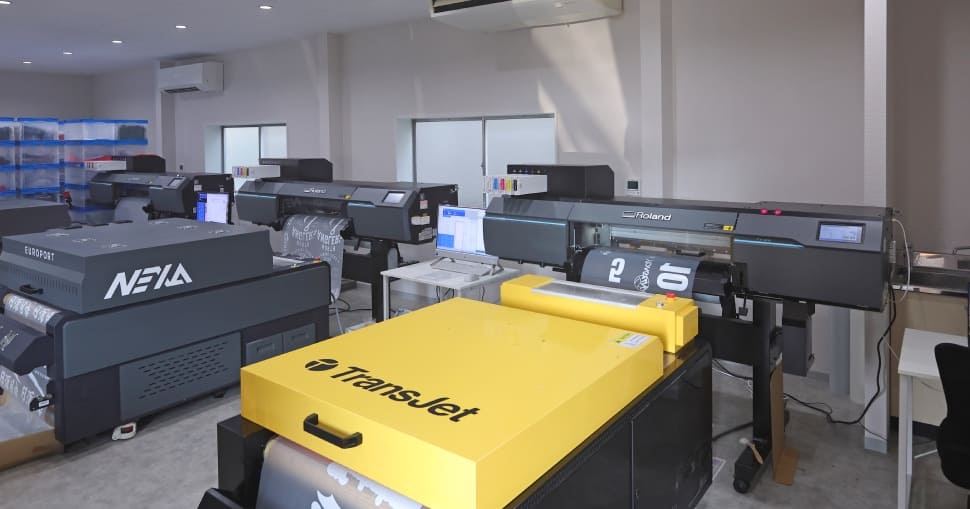
Excel Plus now operates three TY-300i units, with the third recently installed. Previously, the printers sometimes ran 24 hours a day to keep up with demand, but today, each unit can print 40 metres in an eight-hour day at full capacity.
The change has made production faster and more consistent. Morning preparation takes less time, allowing printing to start earlier, while reliable output means Excel Plus can now print in 10-metre runs, compared with the three- to four-metre runs previously possible.
With fewer defects, operators no longer need to stand beside the printers throughout production. Three operators manage the workflow, from sending data to VersaWorks RIP software and checking print status to cutting the film for transfer. These improvements together have approximately doubled daily productivity, reduced defects and enabled Excel Plus to accept more orders with confidence.
“For us as an apparel business, productivity and high quality are the most important,” says Nao. “No matter how high the productivity is, it is meaningless if the equipment cannot produce high-quality output. The TY-300i delivers both at a high level.”Making quality part of the customer experience
For Nao, the benefits of the TY-300i includes more consistent output allows Excel Plus to deliver higher-quality products, with durability that gives customers confidence in their purchases.
“We can now provide customers with higher-quality products that offer excellent durability. The prints truly do not change over time, to the point that we sometimes wonder whether the durability might reduce repeat orders.”
For Excel Plus, the opportunity lies in making personalised apparel easier to produce without compromising quality. With the TY-300i helping the business increase output and serve more customers, Nao is taking another step towards the vision that has guided the company from the beginning: making custom printing accessible to everyone.

