
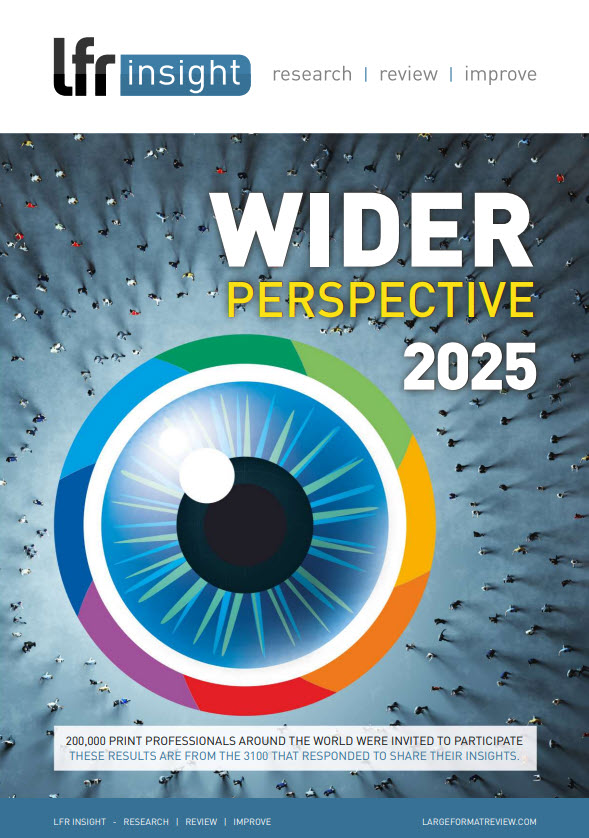
Download the Wider Perspective 2025 report from Large Format Review.
This in-depth industry report shares insight from professionals across the print, sign and display sectors, helping businesses, suppliers and decision-makers better understand the current state of the wide-format print market. The report is presented as the inaugural survey from LFR Insights, Large Format Review’s in-house research platform.
About this report
Wider Perspective 2025 is a research-led report created to capture and share market knowledge that can help shape the future of the wide-format print industry. According to the report, more than 200,000 print professionals in the UK, Europe and the USA were invited to participate, with over 3,000 respondents contributing insights. The document describes itself as the largest print industry survey of its kind to date.
The report is designed to help readers:
- benchmark their own business against wider market sentiment
- identify emerging trends in production, investment and customer demand
- understand how AI and sustainability are influencing the sector
- see where manufacturers, media brands and technologies are viewed most positively by respondents
What Wider Perspective 2025 covers
The report is structured around three core themes:
1. The Business of Print
This section explores revenue, profitability, business confidence, service mix, commercial pressure and customer priorities in wide-format print.
2. The Technology of Print
This section looks at hardware ownership, likely future investment, software usage, finishing equipment, AI adoption and perceived innovation across the market.
3. Environmental Considerations
This section examines how sustainability expectations differ between larger and smaller print businesses, and what actions companies are already taking to improve environmental performance.
Key findings from the report
The findings below are taken directly from the PDF and give a snapshot of some of the report’s most useful insights.
Revenue is up, but margins remain under pressure
The report shows that 72% of respondents said annual revenue increased in the last year, yet 53% said profit margins decreased. The report links this tension to inflation and supply-chain-related cost increases.
Business optimism is stronger than industry optimism
While 57% of respondents were optimistic about their own business prospects over the next two years, only 44% were optimistic about the printing industry overall.
Quality, service and speed matter most to customers
When respondents were asked what they believe clients prioritise most, the leading answers were quality (86%), customer service (82%), rapid job turnaround (76%) and price (71%). Sustainability was lower at 30%, though still clearly relevant.
AI is already active in many print businesses
The report states that 57% of respondents are actively using AI software technologies, while 17% are exploring AI and 26% have no plans at present. Among those considering AI, key use cases include improving operational efficiency, enhancing customer experience and enabling faster data-driven decisions.
Sustainability expectations vary by business size
Among larger print businesses, the report says 58% of existing customers now demand environmentally friendly products, while 52% of new or potential customers actively enquire about environmental credentials. For smaller businesses, those figures are lower at 26% and 23% respectively.
Why this report matters
For print service providers, manufacturers, software developers and suppliers, Wider Perspective 2025 offers a practical view of what businesses are experiencing on the ground. The report explains that its findings are intended not only to inform print companies, but also to help manufacturers assess market demand, compare strategy with real-world feedback and shape future R&D and product direction.
In other words, this is not just a survey summary. It is a decision-support resource for anyone involved in wide-format print.
Who should read Wider Perspective 2025?
This report will be useful for:
- wide-format print businesses
- sign makers and display specialists
- print resellers and production managers
- hardware manufacturers
- software providers
- media and materials suppliers
- anyone tracking trends in AI, sustainability and investment in print
Download the PDF
Use the link below to access the full report:
Download Wider Perspective 2025 PDF
Source: Wider Perspective 2025, published by Large Format Review / LFR Insights.
FAQ
Wider Perspective 2025 is a wide-format print industry report published by Large Format Review through its LFR Insights research platform. It covers business trends, technology, AI adoption and sustainability in the print, sign and display sectors.
The report states that more than 200,000 print professionals were invited to participate and that over 3,000 respondents shared their insights.
The report covers three main areas: the business of print, the technology of print and environmental considerations. It also includes findings related to AI usage and investment plans.
The report says 57% of respondents are actively using AI, 17% are exploring it and 26% have no current plans. Reported AI use cases include operational efficiency, customer experience, data-driven decision-making and cost reduction.
The report finds that sustainability expectations are stronger among larger print businesses, with 58% reporting demand for environmentally friendly products from existing customers, compared with 26% among smaller businesses.